
Wild West Pioneers · Game Guides · Guide
Wild West Pioneers Settlement Layout — Town Hall, Warehouse and Food Shop
A Wild West Pioneers settlement layout guide: Town Hall rotation, main road direction, where the first Warehouse goes, Food Shop range and when to restart.
What a Good Starting Layout Looks Like
The short answer for a Wild West Pioneers settlement layout is to keep daily resident needs compact and let resource buildings stretch outward only when the resource itself requires it. Concretely: choose a Town Hall site with wood, early food and water within one small area, aim the main road toward the first housing block, keep the opening Warehouse near the resources the town keeps moving, and reserve a central slot on the main road for the Food Shop before filling the area with Tents. The Steam page supports the general principle — it describes building and managing growing settlements and establishing production chains — while the developer's own trailers and streams describe placement as deliberately forgiving rather than a puzzle.
The common failure is not a single misplaced building. It is a footprint built one reasonable-looking decision at a time, until the town is effectively several disconnected districts and every future fix has to be built on top of the same distance problem.
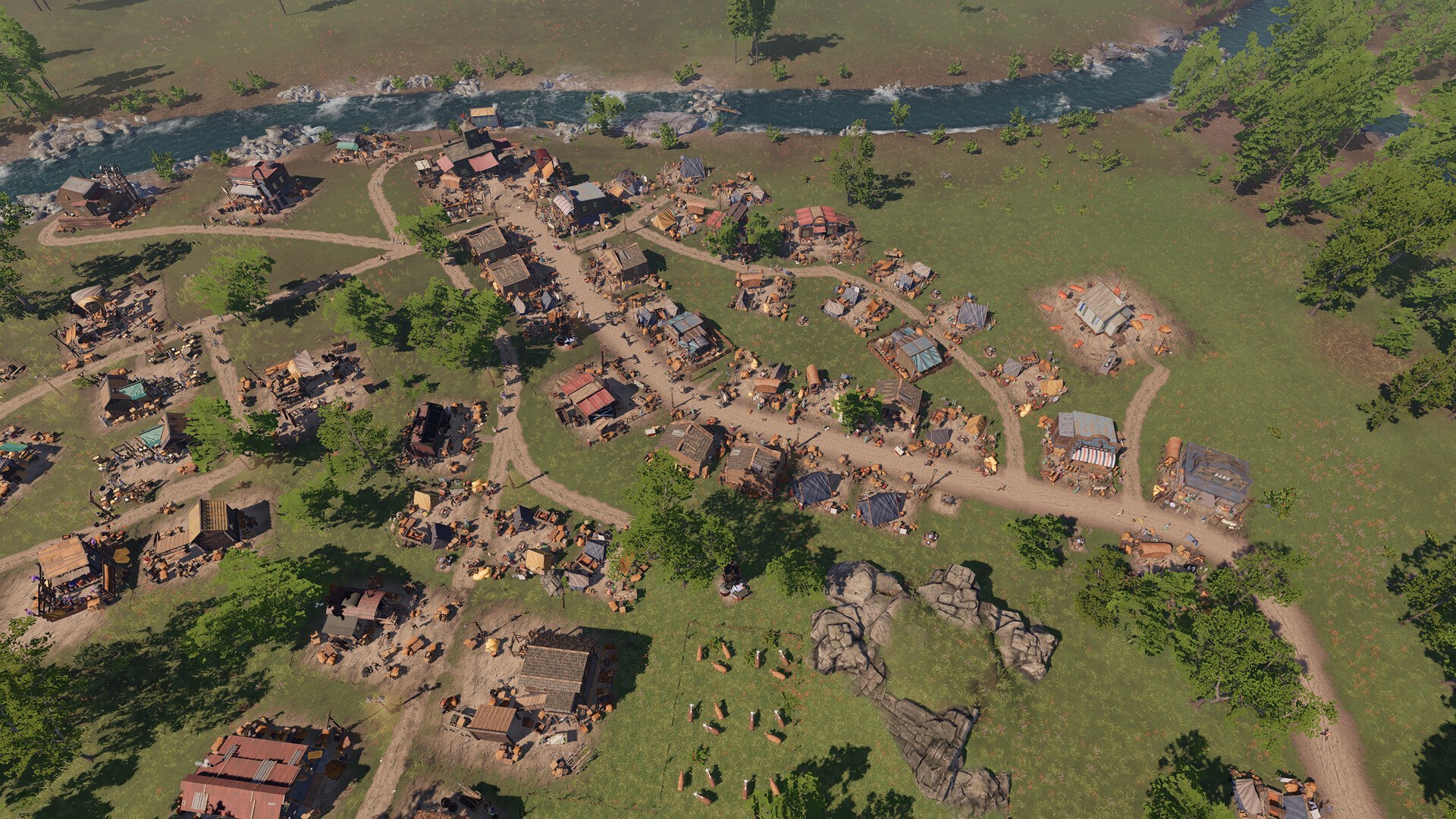
Read the Map Overlays Before Placing the Town Hall
The Town Hall feels like the first decision, but the information you need is already visible before you place it. Toggle the map views and read them in this order.
| Map view | What it shows | Why it changes the layout |
|---|---|---|
| Forest Goods | Mushroom patches and deer | This is your early food, so it should sit close to the resident core |
| Surface Water | Accessible river water | River water can be used directly, so this makes a starting area convenient immediately |
| Underground Water | Aquifer area for future Wells | Determines where a Well can later serve the housing block |
| Mining | Mineral deposits including saltpetre and gold | A distant deposit is not a reason to stretch the opening settlement toward it |
| Soil Quality | Land that gains value once farming unlocks | Permanent town-centre buildings should not consume the best agricultural ground |
For the first few days, food and wood matter more than an isolated mineral deposit. A resource marker on the edge of the area may look strategically important, but widening the footprint to reach it creates a cost long before that resource solves anything. Good soil deserves the opposite kind of attention: you may not need farms yet, but paving over the strongest ground with permanent buildings is expensive to undo.
Town Hall Rotation and the Main Road
The main road extends outward from the Town Hall, which makes rotation functional rather than decorative. It is also unique — you can extend it with the main road button, but you cannot create a second main road any other way, and placing the Town Hall is what determines where it starts. The plotter's first housing and resident services should therefore be chosen before you confirm the Town Hall, so the road points at them instead of at whichever distant resource happens to look useful.
The opening structure can stay simple: Town Hall, then main road, then housing and resident services along it, with the Warehouse and resource buildings branching off toward forest and food. That gives the town one clear daily-use corridor instead of scattering the first six or seven buildings in separate directions. Smaller side roads become useful as the footprint grows, but the opening does not need a dense grid — a short branch added for a real building connection beats reserving large gaps for roads that may never exist.
Where the First Warehouse Goes
The opening instructions point the first Warehouse toward a large patch of trees, which makes sense: permanent log production is one of the first things the settlement needs, and the Warehouse is described as essentially free to place. A large nearby forest is a strong anchor, as long as the placement does not pull logistics away from the rest of the first town.
"Central" has a specific meaning here. It means close to the resources the first town repeatedly moves, not equidistant from the borders of the map.
| Building | Where it belongs | What limits it |
|---|---|---|
| Town Hall | Compact zone with wood, early food and water; off the best soil | Its rotation fixes the main road direction |
| Warehouse | Between the resident core and the resource pockets it serves | Its radius, which scales with assigned workers |
| Gatherer's Hut | Next to a usable mushroom patch, not next to the Town Hall | Access to the patch, plus Warehouse coverage |
| Logging camp | In a large tree patch | Warehouse coverage, not walking distance |
| Kitchen | In range of the Warehouse that handles its ingredients | Staffing, which caps its throughput |
| Food Shop | On the main road inside the first housing block | Range along the main road |
| Well | Where it can cover the housing block that needs it | Underground water availability |
Once the first Warehouse is working, extractors can branch away from the core rather than forcing the core to follow every resource node. A second Warehouse is worth building when distance, storage or coverage genuinely slows the flow — not every time a new resource marker appears.
Food Shop Range Defines the Housing Block
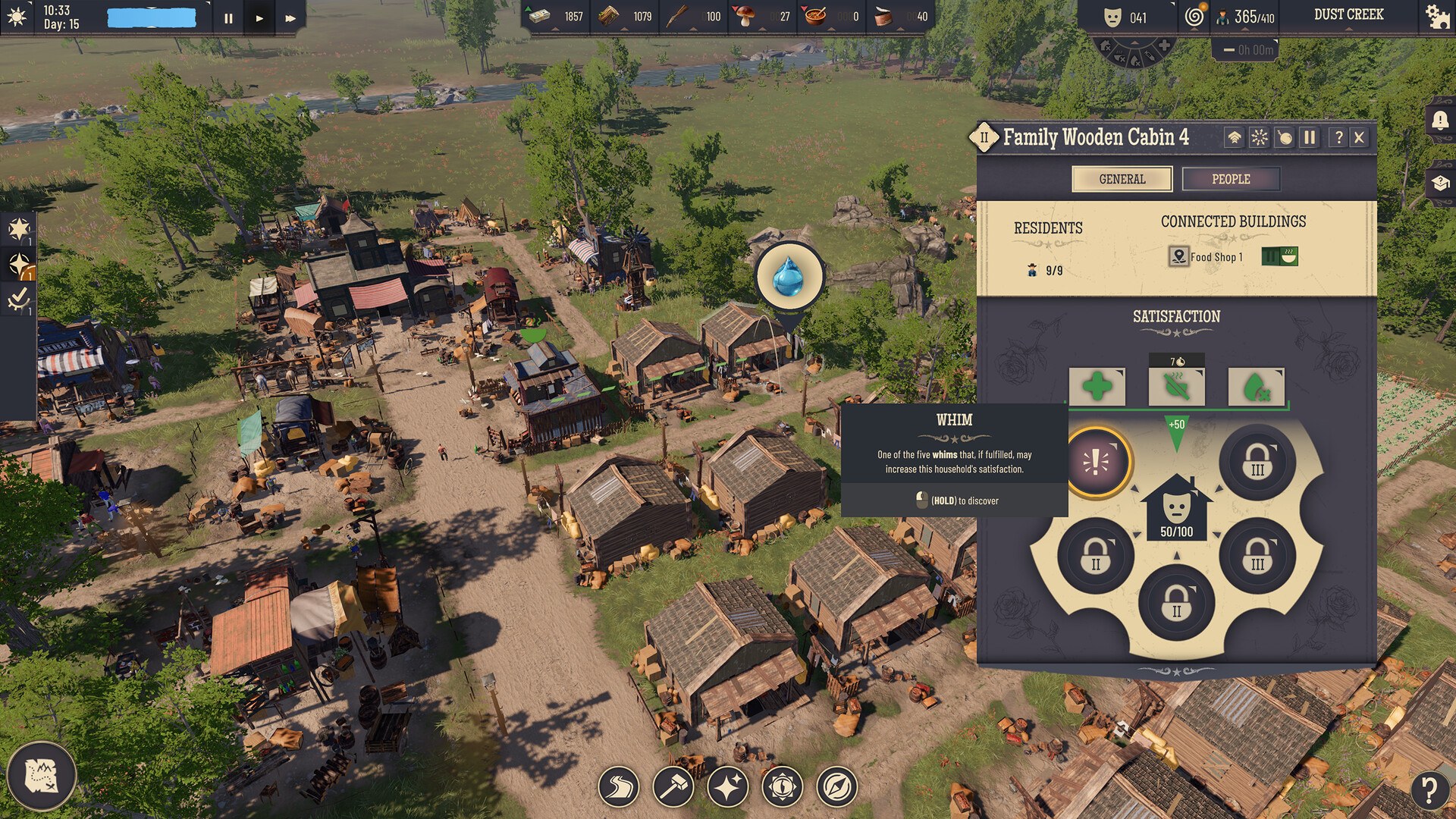
The first residential area looks flexible until food access enters the picture. A Tent shows a residence capacity that fills quickly, and the opening builds a cluster of them; in the 25 September 2026 Early Access build a Tent was observed holding five residents, with six Tents covering the 30 starting settlers, so the first housing block is a fairly dense patch of the settlement. Those values are still being balanced, so treat them as to confirm.
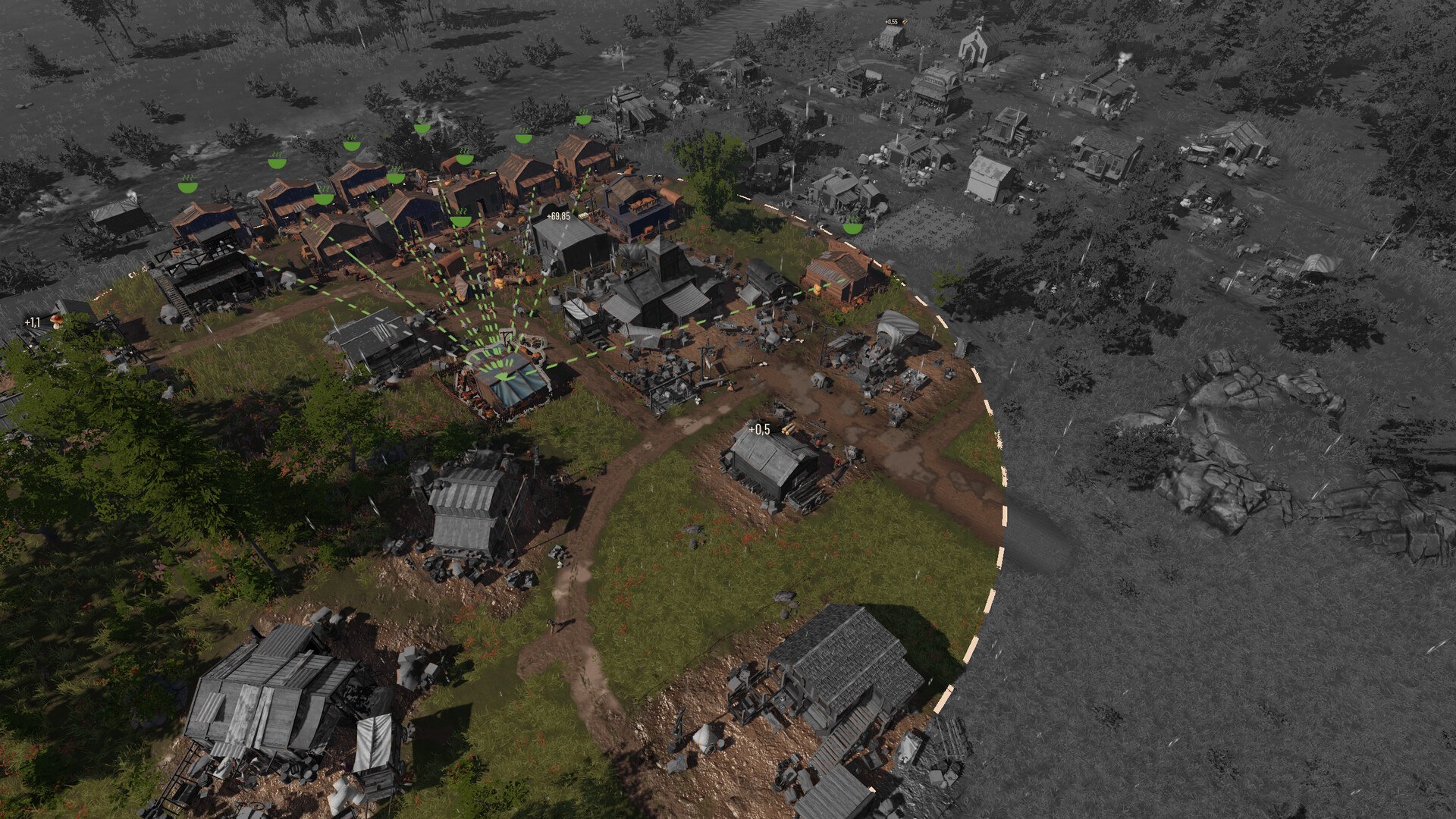
Road connection matters, but Food Shop coverage becomes the more restrictive shape. A Kitchen can be producing food while homes still report they cannot buy any, and the useful reach of the Food Shop improves along the main road — which is another reason to treat that road as the residential backbone. Rather than lining both sides with Tents immediately, leave a service slot near the middle and let housing grow around it.
- Put the Food Shop near the centre of the planned housing, on the main road.
- Keep Tents inside that first service radius before extending the row further along the road.
- Add short side roads only where a district actually needs them.
- When later housing starts falling outside the first radius, treat that as the signal to open a new district rather than continue the same row.
Water, Soil and the Land You Have Not Used Yet
Water and farmland compete for layout attention at different times. Surface water makes a starting area convenient straight away, while underground water matters when choosing where a Well can serve the housing block. Checking both before the Tents fill the available space keeps the opening adjustable. If residents are housed but still report missing water, check coverage first — and if the water building is not unlocked yet, the blocker is progression rather than placement.
Soil quality becomes important later, but the damage happens early. Production buildings degrade the soil around their footprint: in the competitor's documented example, a Kitchen and a Moonshiner's Post visibly degraded the ground around them near potato farming. That changes how empty ground near the starting road should be valued. A convenient flat patch is not automatically the best workshop site if it is also the best soil available for future crops.
By mid-game a cleaner separation tends to emerge: resident services around the main-road core, workshops and logistics on less valuable land, and farms on preserved soil with road and warehouse access. The town does not need perfect zoning from the first minute, only enough foresight that short-term convenience does not consume the few places that become strategically useful later.
Fix, Extend, or Restart?
Restarting makes sense much earlier than demolishing half a developed town, but the threshold should be structural rather than cosmetic. The Early Access build is forgiving by design: buildings can be moved with the move button, and the competitor's own account notes that the developers described placement as intentionally forgiving and not meant to be very complex.
| Situation | Verdict | Why |
|---|---|---|
| One awkward Gatherer's Hut in the wrong spot | Fix it | Move the building, or cover the patch with a second Warehouse |
| A road that runs at an odd angle | Leave it | A crooked road does not block production and can be extended later |
| Housing that has grown past the first Food Shop radius | Extend | Add a second service centre near the new housing rather than rerouting the town |
| The main road points away from the useful residential ground | Restart | The main road cannot be re-created elsewhere, so the error is permanent |
| The first Warehouse suits neither the forest nor early food | Restart | It is the logistics anchor for the whole opening |
| Mushroom gathering already needs a separate logistics pocket | Restart | This is the first sign the footprint is splitting into disconnected districts |
| Distance is noticeably slowing the town before food is even stable | Restart | Every later fix would sit on top of the same distance problem |
The First Footprint Worth Repeating
The exact map changes from run to run, so there is no single street plan worth copying tile for tile. What is worth repeating is the sequence of spatial decisions.
- Find the overlap between early food, a strong tree patch, usable water, and land worth keeping open for later.
- Place the Town Hall so its main road heads toward the residential side rather than toward an isolated future resource.
- Put the first Warehouse close enough to the forest to support logging without dragging the town away from food.
- Grow housing compactly along the main road, reserving a slot for the Food Shop before every useful tile is occupied.
- Let gatherers and other extractors stretch outward toward their resources, and reconnect those pockets with Warehouses and short road branches.
- Keep an eye on unused land: strong soil, practical water access and room for later services all become more valuable as the settlement grows.
That produces a first town with three distinct jobs: a compact resident core, a logistics spine through the middle, and resource production spreading outward. Once those three parts are working, the layout has done its job, and the next expansion should answer an actual resource or service need rather than empty space on the map.
FAQ
- Where should you place the Town Hall in Wild West Pioneers?
- In a spot where wood, early food and usable water all sit within one compact area, rather than at the geometric centre of the map. It does not need the middle of the starting zone, and it should avoid occupying the strongest soil if you can help it, because that land becomes valuable once farming unlocks. Inspecting the resource overlays before confirming the placement is what makes this decision.
- Does Town Hall rotation actually matter?
- Yes. The main road extends outward from the Town Hall, so the direction you rotate it in decides where the opening residential corridor runs. Because that main road cannot be created anywhere else, the rotation is part of the layout decision rather than a cosmetic choice.
- Where should the first Warehouse go?
- Close to the resources the first town actually keeps moving, and within reach of both the forest and early food. A large tree patch is a strong opening anchor, but the Warehouse should not drag the residential core away from the mushroom and food area. The opening instructions point the first Warehouse toward trees because permanent log production is one of the earliest needs.
- How far does a Food Shop reach?
- Its useful reach improves along the main road, and residences have to sit inside that range before they can buy food. A Kitchen can be producing food while homes still report nothing available, purely because they are outside the Food Shop radius. That makes Food Shop coverage the shape that should define the first housing block, not something added afterwards.
- When should you restart a settlement instead of rebuilding?
- When several structural problems reinforce each other: the Town Hall and main road face away from the useful residential ground, the first Warehouse suits neither the forest nor early food, mushroom gathering already needs a separate logistics pocket, and the first Food Shop cannot cover the planned housing. A crooked road or one badly placed building is fixable with the move button. A footprint where wood, food, housing and logistics all want to grow in different directions usually is not.
More in Game Guides
More game guides pages in Wild West Pioneers.
Wild West Pioneers Buildings — Production Chains and Unlock Order
GuideA Wild West Pioneers buildings guide: how Ideas unlock construction, the food, wood and materials production chains, building ranges and upgradeable structures.
Wild West Pioneers Guide — How to Start and What to Unlock First
GuideA Wild West Pioneers guide to the first settlement, settler needs, Journey Points, the Ideas tech tree, scouting and the World Map in the Early Access build.
References
- Wild West Pioneers Best Settlement Layout Guide
- Wild West Pioneers | City Building And Management Set Against The Backdrop of the American West — Toplitz Productions
- Wild West Pioneers on Steam — store page and app details (appid 3222640)
- Build Your Own FRONTIER TOWN - Wild West Pioneers - Early Access — YouTube
- Wild West Pioneers - Starting a New SETTLEMENT | Citybuilder Lets Play Part 01 — YouTube
Facts on this page are compiled from the references above. Items marked "to confirm" are single-source and not yet verified.