
Wild West Pioneers · Game Guides · Guide
Wild West Pioneers Guide — How to Start and What to Unlock First
A Wild West Pioneers guide to the first settlement, settler needs, Journey Points, the Ideas tech tree, scouting and the World Map in the Early Access build.
Where a Wild West Pioneers Run Actually Starts
A Wild West Pioneers guide comes down to three moves at the beginning: keep the first settlement compact, stabilise logs and food, and then spend Journey Points on whatever is blocking progress right now. The Steam page frames the game as a city-builder adventure about leading settlers into the untamed frontier, where you build and manage growing settlements, establish production chains and explore the world. The publisher's product page adds the detail that matters for planning: you lay the groundwork for settlements, decide who leads the city, establish chains for food and wood so each settler's needs are met, and then send another trek out to expand before setting up trade routes and preparing the land for a railroad network.
The Early Access build rarely presents one obvious wall. More often several things become available at once, and the useful question stops being "what can I build next" and becomes "what is actually stopping this town". A food shortage, an uncovered house, low satisfaction, a locked Idea and an expedition that is not ready all look like a stall, but each belongs to a different system.
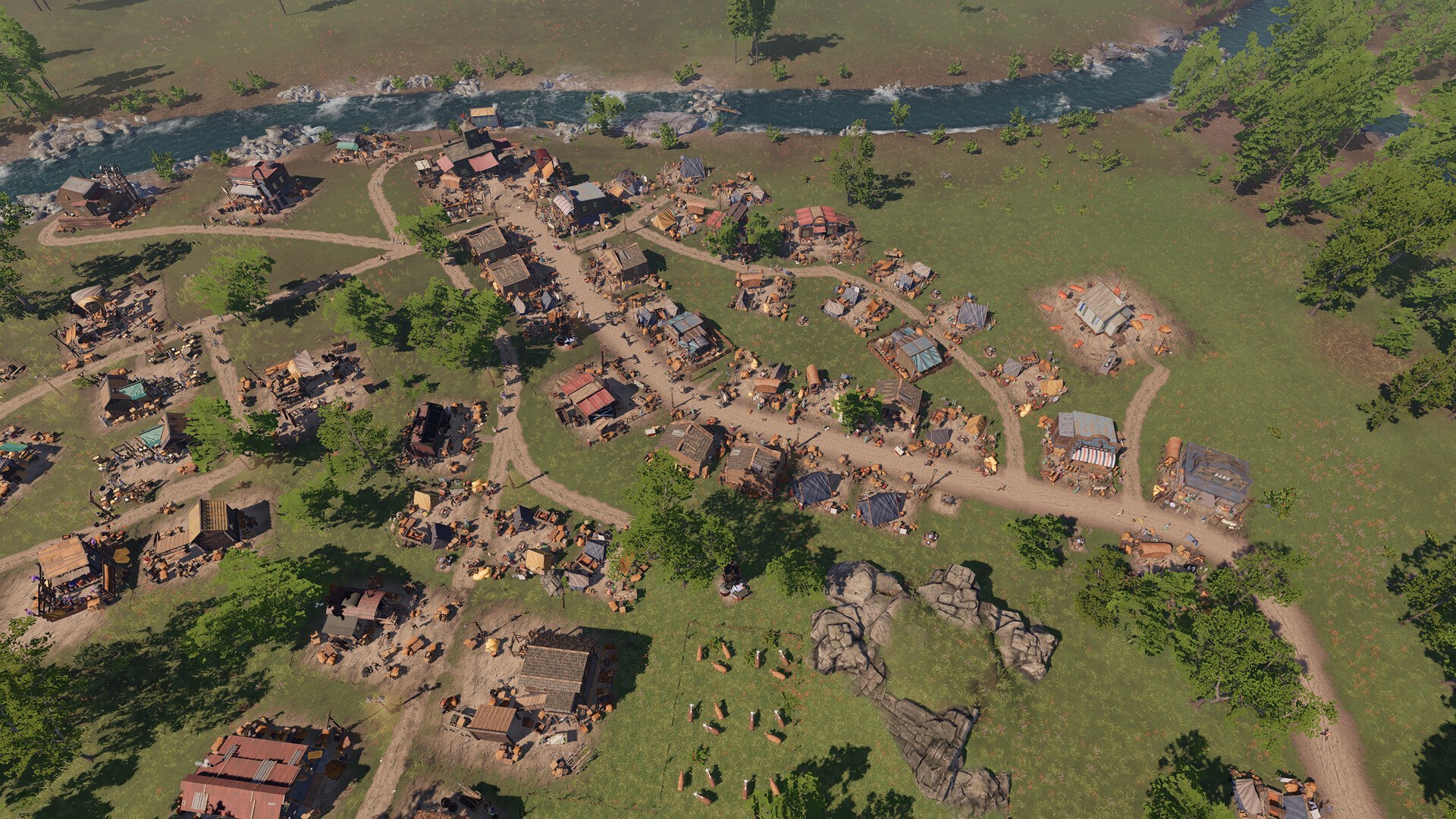
The Opening Sequence, in Order
| Order | What you are doing | Why it matters at this stage |
|---|---|---|
| 1 | Place the Town Hall | It is the heart of the settlement and the start of the main road, so its position fixes everything that follows |
| 2 | Lay the first roads | Road placement is free in the Early Access build, and buildings need a road connection before they function |
| 3 | Unlock and build housing | Tents come out of the Ideas tree, not the build menu, and homeless settlers subtract from satisfaction |
| 4 | Secure water | River water can be used directly; underground water needs a Well before it counts |
| 5 | Unlock the food chain | Gatherer's Hut, then Kitchen, then Food Shop — all three are needed before residents can actually buy food |
| 6 | Get permanent logs running | Logging camp plus a Warehouse in range turns a one-off starting stock into a real supply |
| 7 | Satisfy Whims and keep satisfaction climbing | Above the documented threshold the town starts attracting new settlers on its own |
| 8 | Open scouting | The Scout Cabin, then the World Map, then a second settlement once the first town has surplus |
The first run is easier if you treat the opening as a sequence of stabilised systems rather than a shopping list. In the 25 September 2026 Early Access build the observed pattern was 30 starting settlers, five residents per Tent, and six Tents needed before nobody was homeless — numbers that are still being balanced, so treat them as to confirm.
The Core Loop: Needs, Production and Satisfaction
Two systems run side by side. Production converts raw resources into finished goods, and satisfaction decides whether people stay and whether more arrive. The Steam page lists production chains for food, building materials, tools and luxury goods, turning raw materials into increasingly sophisticated products. The satisfaction side is described there too: food and shelter may be enough at first, but a thriving town needs more, and keeping people satisfied and earning their trust is what turns a settlement into "a true jewel of the Frontier".
When progress stalls, match the symptom to the system rather than to the build menu.
| Symptom | System that is actually failing | Where to look |
|---|---|---|
| No food is being produced | The food chain is incomplete | Gatherer's Hut coverage, Kitchen staffing, then the Food Shop |
| Food exists but specific homes still cannot get it | Coverage, not production | Food Shop range and residential placement |
| Logs or planks never stay in stock | Raw supply or warehouse links | Logging camp, Warehouse radius, worker counts |
| Residents are housed and fed but satisfaction is flat | Needs beyond survival | Whims, amenities and decoration requests |
| The economy is stable but the next system is unavailable | Progression, not placement | Journey Points and the Ideas tree |
| The Scout Cabin is built but exploration is not moving | Expedition setup | Whether the party is actually sent, and whether the location needs an interaction |
| Expansion is available but the first town has no surplus | Readiness | Stabilise the original settlement before committing people elsewhere |
Journey Points, Ideas and the Tech Tree
Journey Points unlock Ideas, and Ideas are where most of the game's buildings and town benefits live. In the Early Access build the construction menu is deliberately thin until you research, which is why the opening feels restricted. Points arrive from three broad sources: completing Journey quests and progression tasks, from the town advancing, and from fulfilling Settler Whims that pop up over individual homes. Whims are usually inexpensive to satisfy and are one of the most reliable point sources early on, so it pays to clear them promptly rather than let them sit.
The official Early Access note describes the launch scope as a set of upgradable buildings, multiple biomes, a world map that interconnects multiple settlements, fully simulated settlers, appointable citizen roles and expeditions. The publisher page adds that the journey through the frontier is yours to shape: you choose which goals to follow and how to spend the rewards. The practical rule is to buy the unlock that removes your current blocker rather than the most expensive node on the tree.
Scouting, the World Map and a Second Settlement
Scouting is the first system that reaches outside the settlement. The Steam page describes sending Scouts to discover new locations, interact with the environment, meet the people already there, and find places where your pioneers can set up their next camp. The publisher page frames the same loop as charting your course westward. The Epic Games Store listing spells out the flow that follows: a strategic map for planning, expeditions, trading outposts, and wagons of explorers dispatched to found new settlements, with sandbox behaviour so no two runs match.
Two cautions are worth carrying into it. First, an expedition temporarily removes workers and supplies from the local economy, so send one when the town can spare them. Second, World Map objectives do not always complete on arrival: some locations need an interaction inside them before the current objective moves on. The overall shape of a run is compact first town, stable logs and food, resident needs, useful Journey unlocks, processed materials, scouting, the World Map, and finally a second settlement whose value is access to different resources rather than a copy of the first.
Beginner Tips That Change How You Play
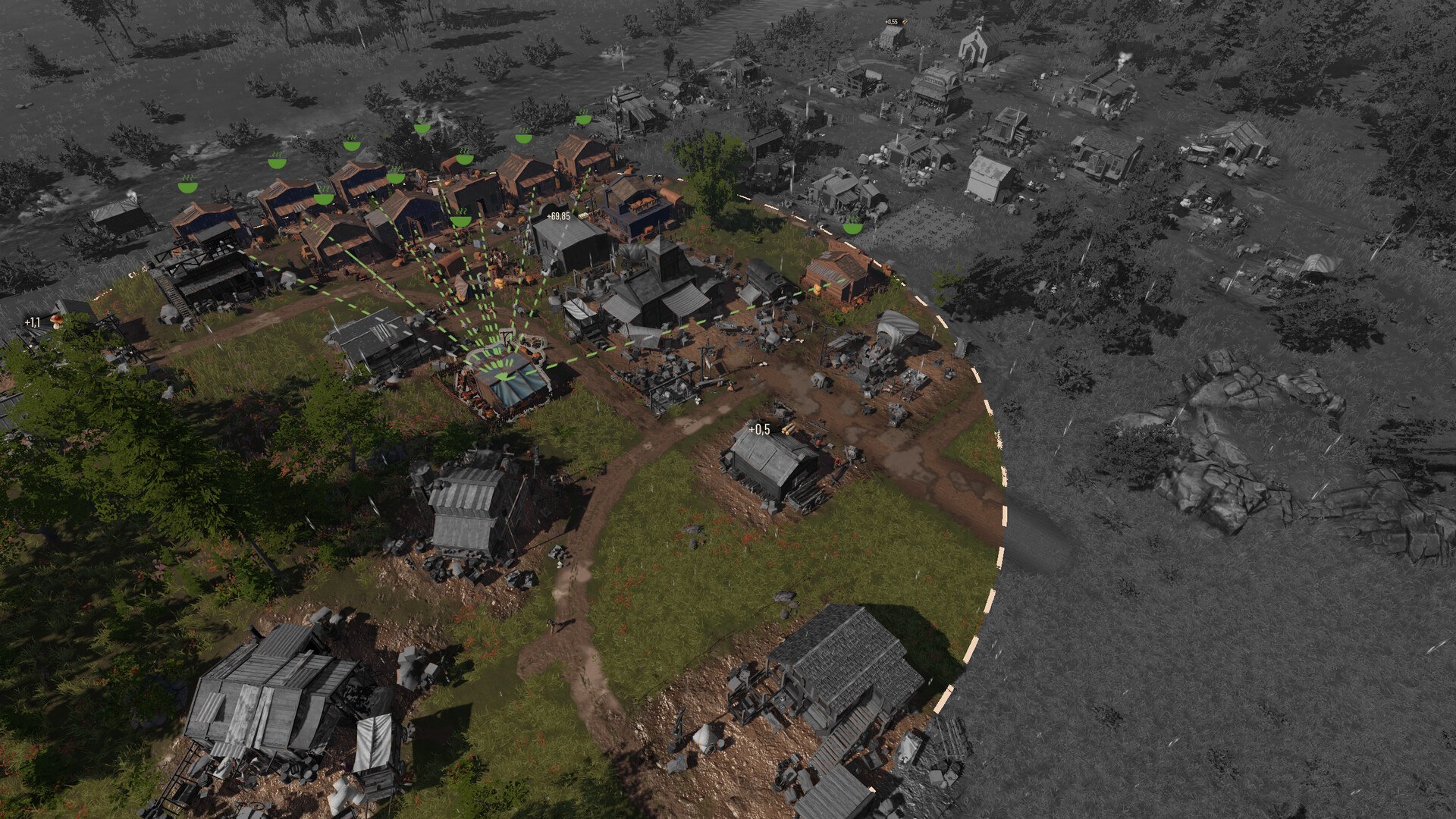
- Read the map views before placing anything. Filters for forest goods, surface water, underground water, mining and soil quality are available at the start, and they are what tell you which land is worth keeping close and which is worth preserving for farms later.
- The main road is unique. The road running out of the Town Hall is the only main road you can have, and it can be extended with the main road button but never created elsewhere. Placing the Town Hall also places the start of that road.
- Distance is forgiving; coverage is not. A long road does not slow production. A production building outside the Warehouse radius does, and building radii scale with assigned workers rather than with the footprint you see at construction time.
- Relocate instead of living with it. Buildings can be moved with the move button, which makes a slightly wrong industrial corner a small problem rather than a restart.
- Watch the Ideas tree, not the build menu. If something you need is missing from construction, it is almost always an unspent Journey unlock.
- Use the in-game information panel. The Early Access build ships a built-in info button and quest journal with resource production, resident status and demand breakdowns — the fastest way to check why a chain is idle.
- Expect the economy to change. A hotfix posted on 29 September 2026 cut the caravan cost from 20 canned food to 5 and fixed a settler arrival timer that could climb above 50 hours, which shows how quickly Early Access balance is moving.
What Changes After the First Town
Once the first settlement stops fighting for survival, the emphasis shifts outward. The competitor walkthrough documents the same turning point: Town Hall upgrades broaden the official side of the game, world quests and story clues pull attention beyond ordinary construction, achievements trigger naturally from ordinary milestones such as Ideas and economic progress, and inter-settlement transport becomes more valuable once different towns produce different things. The official material adds appointable roles — the Epic listing names mayors and sheriffs whose perks affect city growth — and a story told through fully voiced dialogue performed by real actors, with choices that shape your relationships and settlements.
Four shifts are worth planning for rather than discovering.
- Town Hall upgrades broaden the official side of the game, so a stable town is what makes them usable rather than a distraction.
- World quests and story clues start competing with ordinary construction for your attention, which is where appointing citizen roles pays off.
- Achievements arrive from ordinary milestones such as unlocking Ideas and growing the economy, so they need no special run to collect.
- Inter-settlement transport becomes valuable once two towns produce different things, which is the real reason to found a second settlement.
The through-line for the whole run is that every new system has to be supported by the economy you already built. Reaching the next unlock quickly matters less than reaching it with enough workers, resources and coverage that using it does not break the town behind you.
FAQ
- What should you build first in Wild West Pioneers?
- Place the Town Hall, then house everyone, then solve food. The opening tutorial asks for a Food Shop immediately after the Town Hall and the first housing, which means unlocking the Gatherer's Hut, the Kitchen and the Food Shop through Ideas before the chain works. Logging follows straight after, because housing, the Gatherer's Hut and the Kitchen are all paid for in logs at the start of the 25 September 2026 Early Access build.
- Why is the Food Shop missing from the build menu?
- Most buildings start locked. In the Early Access build the construction menu only shows a handful of options and the rest live in the Ideas section, which works as the tech tree driven by Journey progression. Unlocking the Food Shop also requires the Gatherer's Hut and the Kitchen along the way, because those are what actually stock it.
- What are Journey Points used for?
- Journey Points are the currency that unlocks Ideas, which are the buildings and town benefits you can research. They come from completing quests, from progressing the town, and from fulfilling Settler Whims. Whims are usually cheap to satisfy, so they are one of the steadiest sources of points in an Early Access run.
- Does the distance between housing and workplaces slow production down?
- Not in this game, according to the developers. In the 25 September 2026 build a long road between a logging camp and the town does not reduce output; what matters is whether the production building sits inside the radius of the Warehouse that handles its goods, and that radius grows with the number of workers assigned to it. That is far more forgiving than Manor Lords-style logistics.
- When should you unlock the Scout Cabin?
- Early, but not at the cost of food and housing. Scouting opens the World Map, extra locations, trade and additional settlement sites, and the shape of a run changes once it is available. An expedition also pulls workers and supplies out of the local economy, so the useful moment to send one is when the town can absorb that absence without a production dip.
More in Game Guides
More game guides pages in Wild West Pioneers.
Wild West Pioneers Buildings — Production Chains and Unlock Order
GuideA Wild West Pioneers buildings guide: how Ideas unlock construction, the food, wood and materials production chains, building ranges and upgradeable structures.
Wild West Pioneers Settlement Layout — Town Hall, Warehouse and Food Shop
GuideA Wild West Pioneers settlement layout guide: Town Hall rotation, main road direction, where the first Warehouse goes, Food Shop range and when to restart.
References
- Wild West Pioneers Guide & Walkthrough: Progression
- Wild West Pioneers | City Building And Management Set Against The Backdrop of the American West — Toplitz Productions
- Wild West Pioneers on Steam — store page and app details (appid 3222640)
- Wild West Pioneers - Beginner Tips You NEED to Know — YouTube
- Wild West Pioneers - Starting a New SETTLEMENT | Citybuilder Lets Play Part 01 — YouTube
Facts on this page are compiled from the references above. Items marked "to confirm" are single-source and not yet verified.