
Substrate: Emergence · Game Guides · Guide
Substrate Emergence Guide — Cells, Genes, Mutations and Rival Labs
A Substrate Emergence guide to the cell loop, genes and mutations, strain cataloguing, rival labs and zone control in the Early Access build.
What Substrate: Emergence Actually Asks You to Do
Substrate: Emergence is a real-time strategy game built on an artificial life simulation, and the official description states the premise in one line: grow colonies of fluorescent cells that mutate, swarm and devour each other in a petri dish arena. You are not commanding units. You are cultivating a population, nudging its evolution, and trying to outgrow rival labs on the same dish.
The practical difference from a normal strategy game is that your army writes itself. Every cell carries a genome, behaviour comes from a miniature neural network and genetic algorithms rather than scripted orders, and the store page is explicit that nothing is scripted. Your job is the setting: what the cells feed on, which mutations you encourage, which strains you keep, and when to spend chemistry as a weapon instead of waiting for natural selection to do the work.
This page covers the systems and the decisions behind them. If you have not opened the game yet, the how to play page in this hub gives the first-session order, and the Steam page carries price, platform and Early Access facts.
The Core Loop: Feed, Divide, Mutate, Select
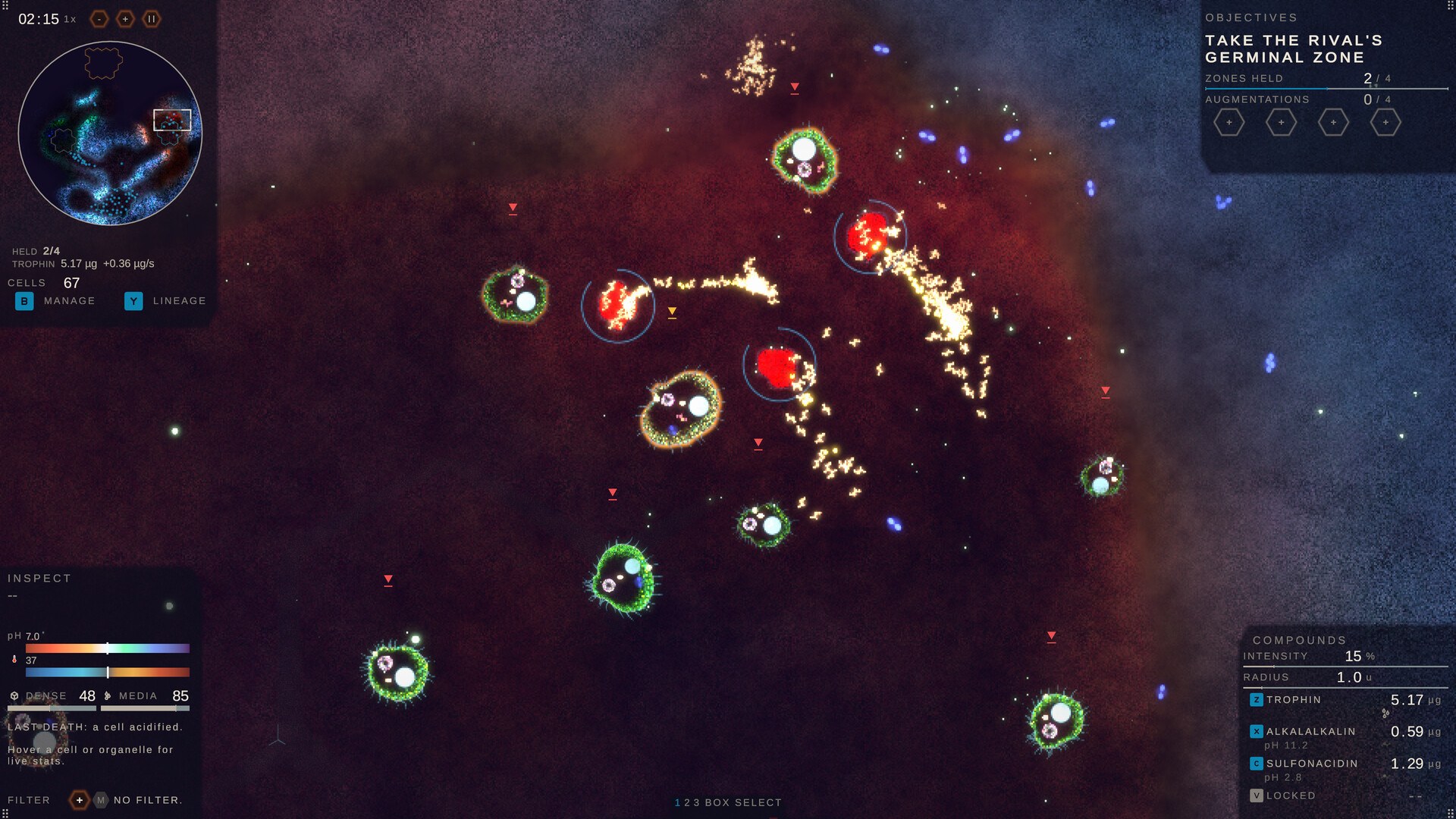
The loop the official material describes is short enough to hold in your head. Cells consume resources, replicate and compete; resources drive behaviour; and the interactions between cells create effects you did not plan. Selection does the rest, because the cells that survive long enough to divide are the ones whose genes reach the next generation.
In the July 2026 demo build that the subtitled walkthrough plays, that loop had a concrete rhythm: a cell has to have its vacuole fuelled before it can divide, its nucleus begins to pulse when it is ready, and each division passes a copy of the parent's genes to the daughter cell (the walkthrough's own reading of the demo UI, to confirm for the current Early Access build). The same build handed out biomarks for culturing valuable cells, and contracts paid a second stream of income for hitting objectives. Both layers are still visible in the Early Access patch notes, which keep touching strain naming, gene filters and the exchange.
- Feed — cells need nutrients before anything else; in the demo the food came from nutrient piles and from spraying a nutrient mix out of the particle tool tray.
- Divide — division is gated on the vacuole, so a hungry culture stalls instead of growing.
- Mutate — genes are copied at division and drift over generations, which is how a lineage becomes a distinct strain.
- Select — heat, pH, starvation and rival cells kill off the weak, and you keep the survivors by cataloguing them.
- Cash out — biomarks fund the lab, and the exchange lets you sell a culture for money to pay for new work.
Genes, Mutations and the Strains You Keep
The store page is unusually specific about the genetic layer, and it is worth treating these as the rules of the system rather than flavour text.
| Official statement | What it means in play |
|---|---|
| Each cell has a unique genome shaping its behaviour and appearance | Two cells in the same dish are not interchangeable, so your stock is individual |
| Cells have functional organelles defined by their genes | Organelles are gene-controlled, which makes a desirable organelle a breeding goal |
| Every gene mutates independently, and any cell can mutate to have any number of any gene | There is no fixed gene limit per cell, so plans have to survive drift |
| Genes pass down through generations, accumulating tiny mutations until they evolve into new strains | A strain is a lineage over time rather than a purchase, and its identity changes as it drifts |
| Every mutation is visible: cells fluoresce as they consume, and each colour reflects genetic code | Colour is a readout you can use to spot a divergent population |
| Behaviour is driven by a miniature neural network and genetic algorithms; nothing is scripted | You cannot memorise a unit counter, so you manage conditions instead |
Catalogue your strains and document their lineages is the official phrasing, and the promise attached to it is that strains become more valuable as they transform into super strains that dominate the substrate. That makes the catalogue a strategic asset rather than a museum: the strain you freeze this hour is the parent of the super strain you field next hour.
Reading a Cell Before You Act
The demo build's inspector is the closest thing to a stat sheet, and its readouts are the vocabulary the rest of the systems use. In that build you hovered a cell to read it, pressed a key to freeze a high-value specimen into the bank, and had a separate screen to review what you had frozen (demo-build behaviour, to confirm for the current build).
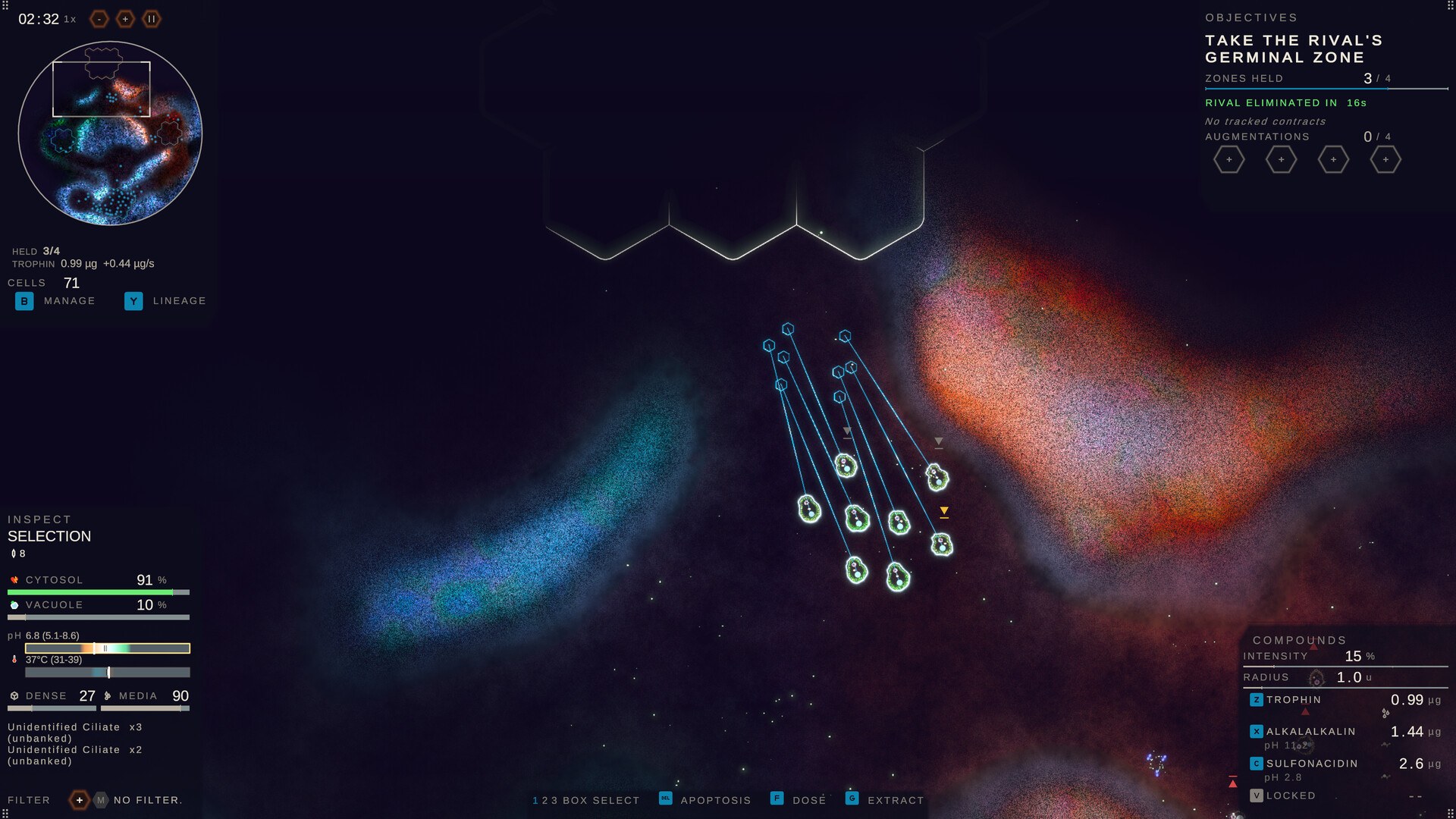
- pH — the dish is not uniform; the demo showed acidic and alkaline areas, and the Early Access patch notes still adjust how those status marks read.
- Temperature and heat — crowding raises heat. One September 27, 2026 patch line states that Act 1 now warns you to keep cells spread out as they divide or they overheat, and that heat is less punishing than it was.
- Motility and behaviour tags — the demo's readout showed labels such as generalist and motile beside a cell's pH reading, which is how you tell a sit-and-wait cell from a coloniser.
- Death cause — death messages were added to say when a cell starved while sitting on growth media and when its own heat killed it, which is the most useful diagnostic added since launch.
Feeding, Chemistry and Why Cells Die
Cells die for reasons that are not always obvious, and the Early Access notes are honest about that: the developer writes that the rest of the game has a lot to explore although it may be a bit obscure, and that the UI is still being made more intuitive. The pressures that kill cells are shared across the demo and the Early Access build.
| Pressure | How it shows up | The lever |
|---|---|---|
| Starvation | Cells die with food nearby if they cannot process it | Uptake and digestive enzyme genes, not just proximity to nutrients |
| Heat | Crowded cells slow down, then overheat | Spacing, plus the Act 1 spacing warning the September 27 patch added |
| pH | Acidic and alkaline areas damage or restrict cells | Reading the dish, painting zones with the pH brush, and the pH status mark that now reads pH+ or pH- |
| Bacterial contamination | Rival bacteria colonise the dish and spread fast | Antibiotic bursts to sterilise, or toxin, which kills any cell it touches, including yours |
| Rival labs | Another culture drains the resources your cells depend on | Claiming zones and using chemistry offensively |
The chemistry layer is where the strategy opens up. Compounds are absorbed with an audible effect, mutagen treatments push a lineage in a direction, and the September 27 notes record that digestive enzyme mutations now reach their maximum in half the generations, which shortens the gap between a mutation appearing and a strain being able to exploit a food source.
The Bionet, the Lab and the Other Surfaces
The Early Access build separates its content into surfaces, and knowing which one you are in explains most of the confusion new players report.
| Surface | What it is for | Documented state |
|---|---|---|
| The lab | Where you grow and engineer a culture and read individual cells | The least explained part of the game, per a September 27 player review the developer responded to |
| Career and story acts | Guided scenarios that double as the tutorial | Highly unfinished and short by the developer's own description, and updated frequently |
| The Bionet | Authored and generated maps with rival AI where you claim zones and fight over resources | Being expanded; patch notes add maps and crystals and adjust the frontier |
| The map editor | Player-authored maps | Excluded from the free demo, which is why the demo cannot show it |
| The exchange and BioExchange | Selling cultures for money and buying cards to fund the lab | Actively patched, including a fix so buy cards list a single unit |
The rival AI is described by the developer as neurosymbolic and is a stated focus for making more challenging. One community broadcast on September 27, 2026 showed rival cultures duelling each other, which is the clearest look at how an opponent culture behaves when you are not the one steering it.
What Early Access Has, and What Is Still Coming
The developer's own Early Access notes are the most reliable boundary here, and they are candid. The core simulation runs and the game is playable; the core game loop is in place but not fully fleshed out; players can progress by cultivating their own lineages and can influence the direction cells evolve in; the challenge is still being established and balanced.
The full version roadmap, in the developer's words, is:
- An in-depth story that doubles as the tutorial.
- Improvements to the UI, tutorial, game mechanics, documentation and variety.
- More authored maps for the Bionet, plus more genes, biology features and mechanics.
- An expanded organic chemistry simulation with more compounds and interactions.
- Multicellularity, deeper viral mechanics and immune responses, and more augmentations.
- More data analysis visualisations such as graphs and charts, and better ways to track lineages.
- More challenging neurosymbolic rival AI, and a fleshed-out economy simulation.
- Full mod support, with tools intended to make authoring as accessible as possible.
None of that is a release schedule, and the price policy is worth knowing before you wait. The developer plans to raise the price as the game expands and is polished, while promising it stays a one-time purchase with no microtransactions.
Build Snapshot: Where These Facts Come From
Everything above is either from the official store text, the developer's Early Access notes, or a build that was live when this page was written. Version numbers move fast in Early Access, so treat the table below as a dated snapshot rather than a description of your install.
| Source | Date | Used for |
|---|---|---|
| Steam store description and app details (appid 4248790) | Retrieved 2026-09-29 | Genome, organelle, mutation, zone, chemistry and catalogue claims |
| Early Access question and answer block on the store page | Retrieved 2026-09-29 | Roadmap, current state, pricing policy and demo limits |
| Steam community news, versions v0.4.6a-15 to v0.4.6a-17 | September 27, 2026 | Heat, starvation messages, gene filter, crystals, Vacuolin and digestive enzyme timing |
| SteamDB Alpha Playtest patch notes, v0.2.8 and v0.2.9 | Alpha Playtest branch | Crystal system, organelle maintenance cost, tutorial and control-hint rework |
| Subtitled YouTube walkthrough, demo build | Recorded July 2026 | Inspector, biomarks, vacuole gating, contracts, exchange and maintenance |
The honest summary for a new player is that the systems are real and deep now, while the explanations around them are still being written. Learn one pressure at a time, keep a catalogue of what survives, and expect the balance to shift under you.
FAQ
- What kind of game is Substrate: Emergence?
- It is a real-time strategy game built on an artificial life simulation. The official store page describes growing colonies of fluorescent cells that mutate, swarm and devour each other in a petri dish arena while you compete against rival labs, and the studio's own summary is that cells divide, mutate and are selected against a substrate you set.
- How do genes and mutations work?
- Each cell has a unique genome that shapes its behaviour and appearance, organelles are defined by genes, and every gene mutates independently, so any cell can mutate to hold any number of any gene. Genes pass down through generations and accumulate small mutations until a lineage becomes a new strain, all driven by a miniature neural network and genetic algorithms rather than scripted behaviour.
- Is there a fixed tech tree or a defined meta?
- No. There is no published tech tree, and the developer states in the Early Access notes that the challenge of the game is still being established and is still being balanced. Treat any claim that one strain, gene combination or opening is objectively best as unverified until that balance work settles.
- How do you beat a rival lab in Substrate: Emergence?
- The store page lists three levers: develop evolutionary advantages so your culture outgrows the competition, use chemistry as a weapon, and claim zones to control the resources your rivals depend on. That layer is still moving, since the Alpha Playtest patch notes reduced organelle maintenance cost and added a crystal system of persistent environmental generators.
- What is missing from the Early Access version?
- The developer says the story and tutorial are highly unfinished and short, the UI and the per-surface guides are still being written, and players should expect bugs and some crashes. There are no Steam achievements and no store review score at the time of writing, so no checklist of completion targets exists yet.
More in Game Guides
More game guides pages in Substrate: Emergence.
References
- Substrate: Emergence on Steam — store page and official app details (appid 4248790)
- Substrate: Emergence — Steam Community Hub (news, patch notes and discussions)
- Petri Dish Games — official studio site and project page
- My Cells are Growing! Lets Check Out Substrate: Emergence — YouTube gameplay walkthrough (July 2026 demo build, subtitled)
- v0.2.9: Taking a different approach for tutorials — SteamDB patch notes for the Alpha Playtest branch
Facts on this page are compiled from the references above. Items marked "to confirm" are single-source and not yet verified.