
Olympus 2249 · Game Guides · Guide
Olympus 2249 How To Play
Olympus 2249 how to play, step by step: sorting the paired attributes, choosing two specializations, reading Karma gates and where XP really comes from.
Olympus 2249 is played in two halves that share one sheet: a character-building half you finish in the first half hour, and a turn-based half that runs for the rest of the game. The short version of how to play is that you choose a preset or build against a set of opposing attribute pairs, pick one combat and one peaceful specialization, then let the Karma system decide which conversations and quests are open to you. This page walks through that order.
How Olympus 2249 Plays: The Short Answer
It is a single-player, isometric, turn-based cRPG. You move a character through a post-nuclear, dieselpunk America, talk your way through some problems and fight your way through others, and the game is explicit that the two routes are both first-class: the store page offers turn-based battles built on positioning, environmental hazards and stamina-powered abilities, and says you can also solve problems without firing a shot. There is no action layer to master and no twitch skill required.
The important consequence is that almost every decision you make at character creation has a matching consequence somewhere later in the game. A character cannot be good at everything, and the official system walkthrough says this is deliberate: it means every run ends up with a hero that is not a copy of the last one.
| Choice | What it is | What it changes |
|---|---|---|
| Attribute pairs | Opposing poles of one trait, for example strength and agility | Caps the opposite pole; six points in one leaves four for the other |
| Presets | Four ready-made character builds | The low-risk first run while you learn the systems |
| Combat specialization | The weapon side of your character | Faster skill growth, special dialogue lines, seven dedicated perks |
| Peaceful specialization | Your peacetime profession, five to choose from | New dialogue options and alternative ways to solve problems |
| Karma | Five Karmic Types, from Moralist to an extreme | Dialogue lines, quest access, how people treat you, some locations |
| Perk budget | 21 universal perks plus seven per specialization | Capped by attributes rather than by level alone |
Step 1: Sort the Paired Attributes
Attributes are grouped in pairs, and each pair is one trait with two poles rather than two separate meters. Strength and agility form your physique: put six points into strength and agility is automatically capped at four, so the hulking bruiser and the nimble acrobat are mutually exclusive. The same rule applies across the sheet, and it is the reason a balanced five-and-five character is the weakest option rather than the safest one, because balance gives up the peak bonuses of both sides.
In combat you need both ends of a pair, which is what makes the choice hard rather than trivial. The practical advice from the official system video is to decide what your character is for before you spend points, and if you are new, to let a preset make that decision for you on the first run.
Step 2: Choose Two Specializations
Character creation asks for two specializations. The first covers your weapon preferences and the second covers your peacetime profession. Skills tied to the specializations you choose grow faster, unlock special dialogue lines and open a set of perks; there are 21 universal perks in the game plus seven for your combat specialization and seven for your non-combat specialization. Some of those perks unlock active combat abilities, so this is not a purely conversational choice.
Because there are five peaceful specializations to choose from, the second slot is a real build decision rather than a formality, and the store page says each one unlocks new dialogue options and new ways to solve problems. If you intend to resolve situations without a fight, this is the slot that makes it possible.
Step 3: Read Karma Before You Talk
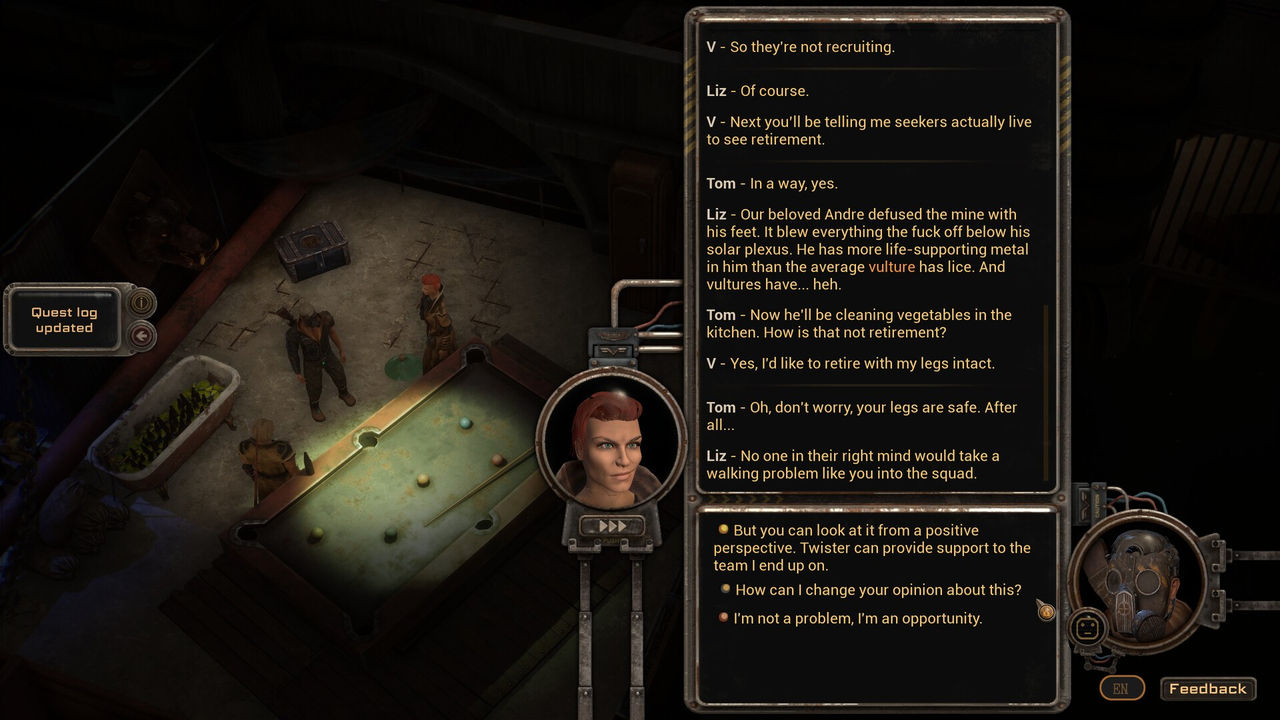
Karma is not a score that creeps upward while you play well. There are five Karmic Types, and in dialogue you have access to the lines of your own type, the two adjacent types and your chosen non-combat specialization. Picking the lines of a neighbouring type accumulates matching points, so your character can gradually shift worldview instead of being frozen at creation. Quests and dialogue move Karma, and Karma moves quests and dialogue.
The hard edge is access. With a given worldview, some quests, some solutions and sometimes entire locations never open to you, while other routes open only for that type, so a single careless reply in a conversation can close a faction for the rest of the run. That makes conversations worth treating like fights: look at what you are about to say, and save first if the outcome matters.
Step 4: Where Experience Actually Comes From
Quests give the largest share of experience, but they are not the only route, and the level curve rewards almost every logical step you take. The official walkthrough breaks it into three streams: quest completion, combat performance and exploration. Combat is not just a kill counter either, which means a careful, low-damage fight can still pay as well as a fast one if you land your hits.
- Quests and side quests hand out the biggest experience totals, so finishing what you started beats farming fights.
- Landing hits in combat earns points toward the specific weapon or combat skill you used, so shooting accurately levels that skill directly.
- Raising a skill also gives points toward your character overall level, which is why a single skill increase can push two meters at once.
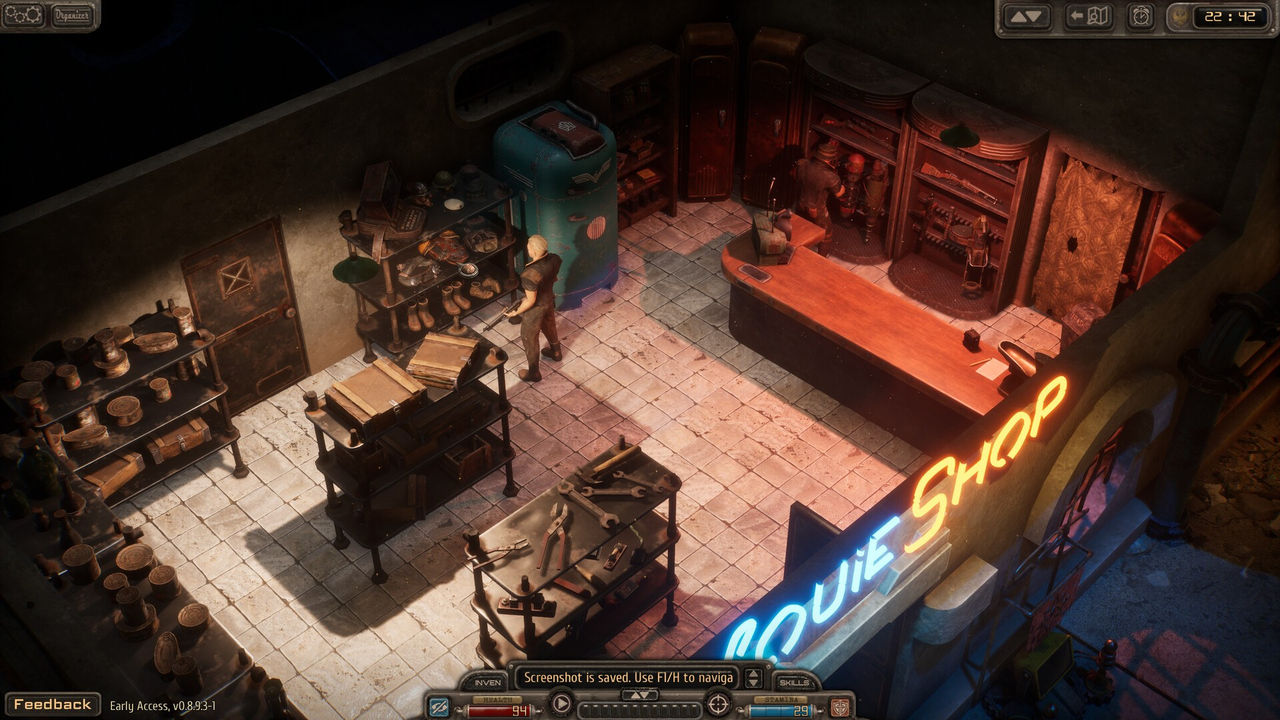
- Unmarked locations reward curiosity: the shooting range near the hero home awards experience for shooting bottles, with no quest attached.
Put the four steps in order and the first hour stops being intimidating. For the systems themselves, combat, stealth, crafting and skills go deeper, and the achievements page lists all twelve Steam achievements and their exact conditions.
FAQ
- How long is the Early Access version of Olympus 2249?
- The developers put the Early Access slice at roughly three to seven hours, and the number depends on your build, your play style and how many side quests you complete. Coverage of the launch adds that the build is the first of three planned acts, with the studio expecting eighteen to twenty-four months in Early Access while it adds locations, factions, quests, characters and items.
- Should I use a preset or build my own character in Olympus 2249?
- Use a preset for your first run. The official walkthrough of the role-playing system recommends taking one of the four presets while you are still learning how the systems fit together, calling them perfectly effective, and suggests building a character around your own play style afterwards.
- How many perks can I take in Olympus 2249?
- That depends on your attributes rather than only on your level. Perks unlock as you gain levels, but you can only take a limited number, and the official system video states that the cap is tied to your attribute values, so a character with peak attributes in one pair will have a different perk budget from a balanced one.
- Does Olympus 2249 reward exploration?
- Yes. Besides quests, which give the most experience, the game rewards curiosity directly: landing hits in combat builds points toward the weapon or combat skill you used, a skill increase also hands you points toward your overall level, and unmarked places such as a shooting range near the starting area hand out experience for no quest reason at all.
- Is there a difficulty setting in Olympus 2249?
- Yes. The store page lists Adjustable Difficulty among the accessibility features, alongside Save Anytime, custom volume controls, stereo sound, keyboard-only and mouse-only options, and a playable-without-timed-input mode, so you can slow the game down if the turn-based fights get rough.
More in Game Guides
More game guides pages in Olympus 2249.
References
- Olympus 2249 on Steam
- Official video: the Olympus 2249 role-playing system and Karma
- RPG Codex: Olympus 2249 announcement and official feature list
- Turn Based Lovers: Olympus 2249 Early Access overview
Facts on this page are compiled from the references above. Items marked "to confirm" are single-source and not yet verified.