
Mimic Party · Gameplay · Page
Mimic Party Multiplayer — How 1-5 Player Online Games Work
How Mimic Party multiplayer works: 1-5 players online, one-shot takes with no turns, voice chat that mutes on playback, aimed sabotages and ten-minute games.
Mimic Party multiplayer is built for one to five players online, with a game lasting about ten minutes. The structure is unusual for a party game in one specific way: there are no turns. A reference sound is revealed to the whole table at the same moment, everybody records on a single shared countdown, and only then are the takes played back one by one while the room reacts. Nothing about a round waits for another player to finish.
The other half of the design is social pressure. Voice chat is live for the whole round except during playback, and between rounds a wheel hands out points, multipliers and sabotages that you aim at someone deliberately. This page covers how a match is structured, what the voice-chat rule actually does, and how to get a group into the same lobby.
The Shape of a Mimic Party Match
The core numbers are documented in two places that agree with each other. The Steam store description calls it "a 1-5 player online voice party game," and the official FoliesApp page gives the frame: one to five players, around ten minutes a game, everything played with a microphone and no controller input deciding a round.
| Match fact | Documented value |
|---|---|
| Players | 1-5 online |
| Session length | About 10 minutes per game |
| Rounds per game | Roughly four rounds, per the official FAQ |
| Input | A microphone; the game is played with the voice |
| Connection | Online multiplayer only, permanent broadband required |
| Voice chat | Built in, always on except during take playback |
| Extra hardware | Headphones strongly recommended |
One clarifying note for anyone who has seen a browser version of Mimic Party: the independent browser edition of the same name is a single-player game and is not the Steam release. The 1-5 player online mode described here belongs to the FoliesApp game.
How a Round Runs, Step by Step
The official page lays the round out as six beats, and they explain why the game feels different from a normal turn-based party title. Everyone is always doing the same thing at the same time until the playback stage.
| Step | What happens |
|---|---|
| 1. The sound drops | A reference sound is revealed to the whole table at once; you hear it only once |
| 2. Everybody records | One countdown for the entire table, so nobody waits through four other attempts |
| 3. One shot | No retry and no re-record; whatever came out is what everyone will hear |
| 4. Playback | Each take plays for the room while the other players are muted |
| 5. Scoring | The AI compares melody, rhythm and attacks to the reference and scores out of 100 |
| 6. The wheel | Points, multipliers and sabotages are handed out before the next round begins |
The no-retry rule is what makes the playback stage matter. Because there is no second attempt, the score is only part of the reaction; the room's response to the take is the other part, and the mute-on-playback rule exists to protect that moment rather than to police chat.
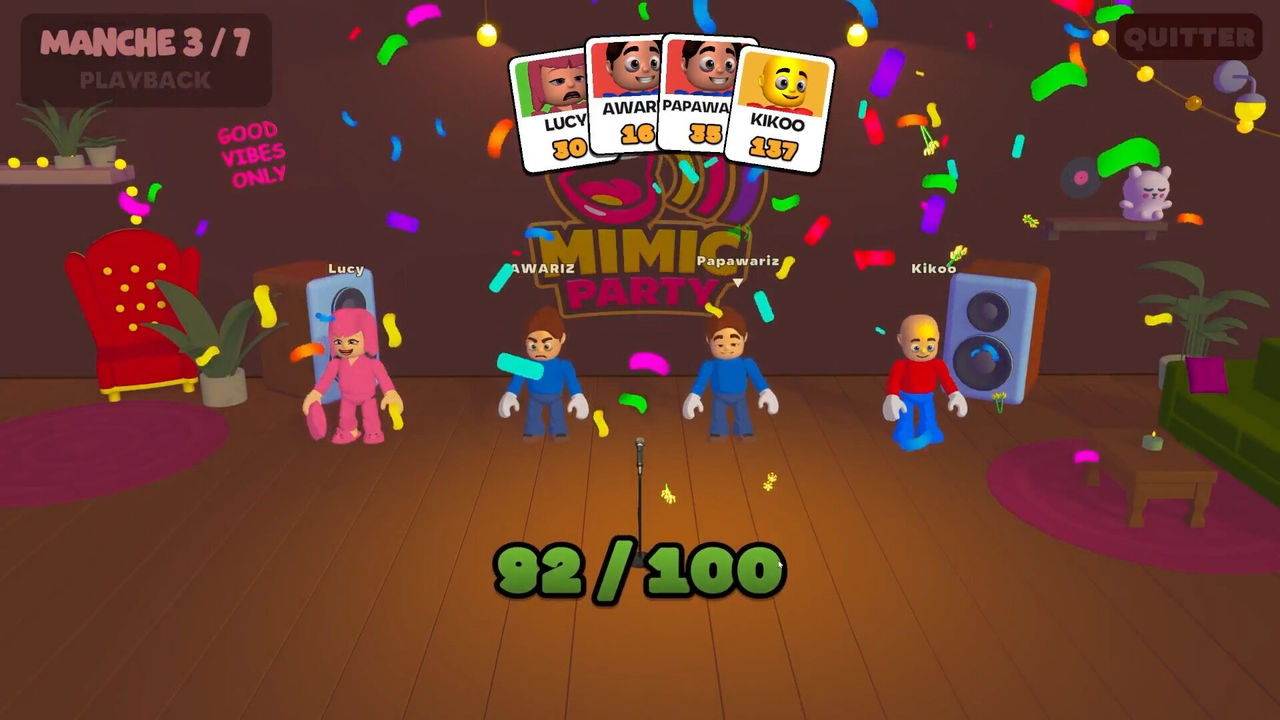
Voice Chat, Turns and the Half-Second Rule
Voice chat in Mimic Party is always on, with one exception that is enforced by the game rather than by etiquette. The moment a take starts playing, the whole table is muted so that every player hears exactly the same audio; the second it ends, the mics reopen in time for the reaction. The official page describes that half-second as the game.
- Always on: the table can talk through the reference, the countdown and the wait.
- Muted on playback: nobody talks over a take, and nobody misses it either.
- Reopened on reaction: the mics come back immediately after the take ends.
- No turns: because everyone records simultaneously, there is no dead time to fill.
For a group new to the game, the practical advice is to let the mute rule do its job and not try to narrate over playback. The game already guarantees the quiet moment; the players' job is the reaction afterwards.
The Wheel, Sabotages and Playing With Friends
Between rounds the wheel spins for everyone at once, handing out points, multipliers and sabotages. A sabotage is aimed: you pick the victim, their next take is altered, and it costs them points on top. The effects documented by the official page are saturation, echo, pitch shift, chopped audio, or the take replaced outright by a garbage sound that the table hears instead of their voice.
- Aimed, not random: you choose who receives the sabotage, which makes the wheel a social decision as much as a scoring one.
- Delayed reveal: the victim finds out who aimed at them only when their own take plays.
- Stacked cost: a sabotaged take loses points in addition to sounding wrong.
- Public scoring: the score lands right after your take, in front of everybody.
Getting a group into the same game follows the normal Steam online-multiplayer path, and the one documented gate is content rather than connection: every player at the table needs a sound pack installed before a game using it can start, and the lobby shows exactly who is still getting it. The precise host-and-invite flow is not described on the official page, so treat the exact button path as to confirm and rely on Steam's standard lobby invitation for the app.
For the round mechanics in more depth, see the how to play guide. For where the sounds come from, see the packs page, and for the base-game facts behind the five-player cap, see the Steam page.
FAQ
- How many players can play Mimic Party?
- One to five players online, according to both the Steam store description and the official FoliesApp page, with a game lasting about ten minutes. Steam's minimum-requirements note phrases online play as 2-5 players, so the exact solo behaviour is worth treating as to confirm against the live build.
- Is Mimic Party turn-based?
- No, and the official page makes a point of it. Every round reveals one reference sound to the whole table at once, everybody records on the same countdown, and there are no turns where one player performs while the others wait. The takes are played back one at a time only after everyone has recorded.
- Does Mimic Party have voice chat?
- Yes, and it is part of the design rather than an add-on. Voice chat is always on except during playback: the moment a take starts playing the whole table is muted so everyone hears exactly the same thing, and the mics open again the second it ends. The official page calls that half-second the heart of the game.
- What are sabotages in Mimic Party?
- Between rounds a wheel hands out points, multipliers and sabotages. You aim a sabotage at a player of your choice, and their next take comes back saturated, echoing, pitch-shifted, chopped up, or replaced outright by a garbage sound, at a cost in points. The victim finds out only when their take plays.
- Do all players need the same sound packs in a lobby?
- Yes. Every player at the table needs a pack installed before a game using it can start, and the lobby shows exactly who is still getting it. That is a multiplayer rule rather than a content rule, and it is the most common reason a group cannot start the round it planned.
More in Gameplay
More gameplay pages in Mimic Party.
References
- Mimic Party, the online voice party game (1-5 players)
- Mimic Party on Steam
- Mimic Party — Steam Community Hub
- Play Free Mimic Party Online | Voice Imitation Game
Facts on this page are compiled from the references above. Items marked "to confirm" are single-source and not yet verified.