
Mimic Party · Gameplay · Guide
Mimic Party How to Play — Rounds, Scoring and the Wheel
How to play Mimic Party: the microphone setup, the one-listen one-take round loop, the local AI scoring on melody and rhythm, and the wheel and its sabotages.
Mimic Party is a voice game, so learning to play it is mostly about two things: getting a microphone working, and understanding that every round gives you exactly one listen and one take. You hear a reference sound once, everybody at the table records on the same countdown, the takes are played back one by one, and a local AI scores each imitation on melody, rhythm and attacks. There is no rehearsal and no second attempt, and between rounds a wheel hands out points, multipliers and sabotages that are aimed at a player of your choosing.
That is the whole loop in a paragraph. The rest of this guide covers the setup, the six beats of a round, how the scoring actually decides your number, and how to survive the wheel.
Before Your First Round: What You Need
The hardware list is short and non-negotiable, because the game routes every decision through your voice. Steam's requirements for app 5053820 call for a microphone and a DirectX compatible sound card alongside a broadband connection, and the official page adds that headphones are strongly recommended so that game audio does not leak back into your take and distort the thing being scored.
| Setup item | Requirement | Why it matters |
|---|---|---|
| Microphone | Required | The entire game is played with your voice |
| Headphones | Strongly recommended | Keeps the reference and feedback audio out of your recording |
| Connection | Broadband, permanent | Online multiplayer only |
| Players | 1-5 online per the official page | The mode is built around a shared countdown |
| Sound packs | Everyone at the table needs the same packs | A round using a pack cannot start until all players have it |
Two practical notes for the first session. Microphone permission is requested only when you start, so grant it before the group is waiting on you. And if your group is mixed-language, agree on the packs in advance, because the lobby will simply sit there naming whoever is still getting the pack until everyone is ready.
The Round Loop From Sound to Score
The official page breaks a round into six beats, and the ordering is what makes the game feel fast. Everything before playback happens to everyone at once, so there is no waiting through other players.
| Beat | What you do | What the game does |
|---|---|---|
| 1. The sound drops | Listen once; there is no replay | Reveals the reference to the whole table at the same moment |
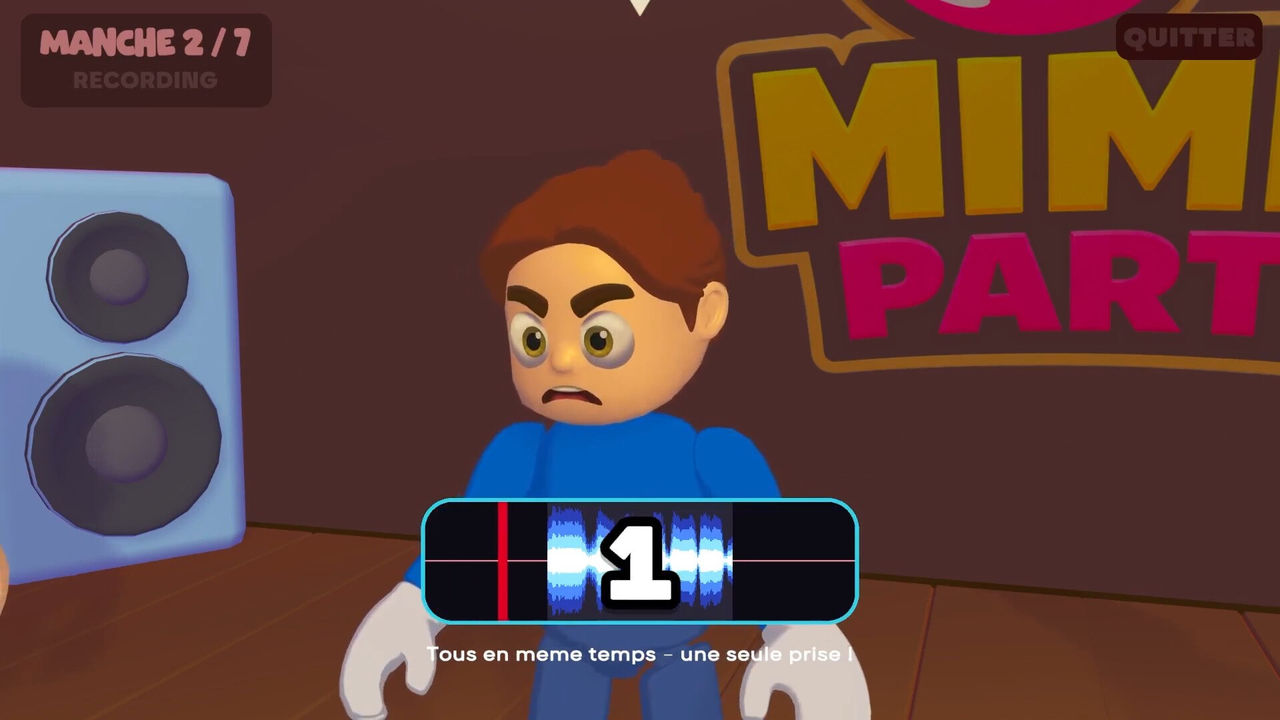
| 2. Recording | Record your one attempt on the shared countdown | Runs a single countdown for the entire table |
| 3. One shot | Nothing — there is no retry | Locks the take you sent |
| 4. Playback | Stay quiet and listen | Plays each take while the other players are muted |
| 5. Scoring | Read your result in front of the table | Compares melody, rhythm and attacks and scores out of 100 |
| 6. The wheel | Aim pending bonuses and sabotages | Spins for everyone before the next sound begins |
The first two beats are where most new players lose points. Because the reference plays once, the useful habit is to copy the shape of what you heard — the rise and fall, the number of barks or beats — rather than trying to recall a perfect impression of the original performer.
How the Local AI Scores Your Take
Scoring is built around what a human throat can reproduce, not around how much you sound like a specific person. The official page lists three scored dimensions and is explicit about what is excluded: melody, rhythm and attacks are compared to the reference, while timbre is deliberately ignored. "A deep voice and a high voice doing the same curve score the same," which means vocal range is not an advantage and a cheap microphone is not a penalty.
| Scoring dimension | How it is judged | Documented detail |
|---|---|---|
| Melody | Relative pitch, not absolute | Your register never counts against you |
| Rhythm | Measured across the whole take | One bark does not pass for three |
| Attacks | Counted on the take as performed | Whether you barked once or three times matters |
| Timbre | Not scored | Deliberately excluded from the comparison |
| Result | Out of 100, shown to everyone | The score lands right after your take |
| Where it runs | Locally on your machine | The round keeps going while it analyses |
That last row is the reason a slow PC does not punish you: the analysis runs on your machine rather than in the cloud, so the score appears without a server round trip and without uploading your voice anywhere. The take is judged on shape, and the shape is exactly what the pack's reference gives you to copy.
Two consequences are worth remembering before your first round:
- Vocal range is not an advantage: a deep voice and a high voice performing the same curve score the same.
- Microphone quality is not a penalty: because timbre is excluded, a cheap headset mic does not cost you points on its own.
The Wheel and Its Sabotages
Between rounds the wheel spins for everyone at once. It hands out points, multipliers and sabotages, and a sabotage is aimed rather than random: you choose the victim. Their next take comes back altered, and the change costs them points in addition to sounding wrong. The victim learns who aimed at them only when their own take plays, which turns the wheel into a social decision rather than pure chance.
- Points and multipliers: the straightforward outcomes, which raise the value of a good take.
- Aimed sabotages: you pick the target, and the target does not know until playback.
- Saturation, echo and pitch shift: the take is played back altered rather than replaced.
- Chopped audio: the take is broken up, so its rhythm no longer matches the reference.
- Full swap: the take is replaced outright by a garbage sound, and the table hears that instead of you.
- Compounding cost: a sabotaged take loses points on top of scoring badly.
First-session advice follows from that list. Aim sabotages at players who are ahead rather than at the funniest take, keep your own reaction short when someone else is being sabotaged, and remember that the voice chat is muted during playback anyway, so the reaction lands after the reveal rather than during it.
After Your First Game
About ten minutes and roughly four rounds is the documented length of a game, which is short enough to treat a session as a few sittings rather than one commitment. Once the loop clicks, the natural next steps are content rather than mechanics: subscribe to more sound packs so the table stops hearing the same references, then look at whether the game can be pushed past its documented five-player cap.
The pages that follow on from this one are the multiplayer page for lobby rules and the wheel in a group setting, the packs page for how sound content reaches the table, and the Steam Workshop page for subscribing to and publishing packs. If you have not bought the game yet, the Steam page covers price and requirements.
FAQ
- How do you play Mimic Party?
- You listen to one reference sound, then record a single take imitating it with your voice while the rest of the table does the same on a shared countdown. A local AI scores each take out of 100 on melody, rhythm and attacks, and between rounds a wheel hands out points, multipliers and sabotages.
- Do you need a microphone to play Mimic Party?
- Yes. The whole game is played with your voice, so Steam's requirements list a microphone as required and describe a DirectX compatible sound card. Any standard mic works, including a gaming headset, webcam mic or laptop mic, and headphones are strongly recommended so game audio does not leak back into your take.
- How does the Mimic Party score work?
- Each take is compared to the reference on melody, rhythm and attacks, which is what a human throat can actually reproduce. Timbre is deliberately ignored, so a deep voice and a high voice performing the same curve score the same. The analysis runs locally on your machine rather than in the cloud.
- What happens if you get a sabotage?
- A sabotage is aimed at you by another player through the between-round wheel. Your next take comes back saturated, echoing, pitch-shifted, chopped to pieces, or replaced outright by a garbage sound the whole table hears instead of your voice, and it costs you points on top. You find out who aimed at you only when your take plays.
- How long does a game of Mimic Party last?
- About ten minutes, which the official FAQ describes as roughly four rounds. That short frame is part of the design, because every round is one listen and one take with no rehearsal, so the game keeps its pace instead of turning into a rehearsal session.
More in Gameplay
More gameplay pages in Mimic Party.
References
- Mimic Party, the online voice party game (1-5 players)
- Mimic Party on Steam
- Play Free Mimic Party Online | Voice Imitation Game
- The Steam Workshop for Mimic Party
Facts on this page are compiled from the references above. Items marked "to confirm" are single-source and not yet verified.