
Qliphah in Providence's Shadow · Game Guides · Guide
Qliphah In Providences Shadow Gameplay — Counter System, Skills and Timeline Combat
A Qliphah In Providences Shadow gameplay guide to the real-time counter battle system, colour-coded attacks, buddy counters, skills and the story map.
What Kind of Game This Is
Qliphah in Providence's Shadow is a real-time action RPG that asks you to read timing rather than memorise combo strings. Arc System Works and UnitePlus released it on September 23, 2026 for Windows, PlayStation 5 and Nintendo Switch, and both the publisher and the store page label it a "Tactical Timeline RPG" — RPGFan prefers the fuller "tactical counter-timeline RPG", which is the more useful description, because almost every system in the game feeds the counter window. You alternate between two leads: Rena Hizuki, an investigator in the Metropolitan Police Department's Public Safety Bureau, and Soma Hoshigami, a delivery worker who is attacked and left half-turned into a mutant. The setting is a Tokyo whose reality is collapsing, and the pair investigate a spreading drug called "Tiny True" alongside a cult operating behind the scenes.
The two leads are not cosmetic swaps. The official character pages give each a distinct mutation, weapon and fighting logic, and RPGFan notes that the pair's relationship is the strongest part of the story.
| Character | Documented role | Documented abilities |
|---|---|---|
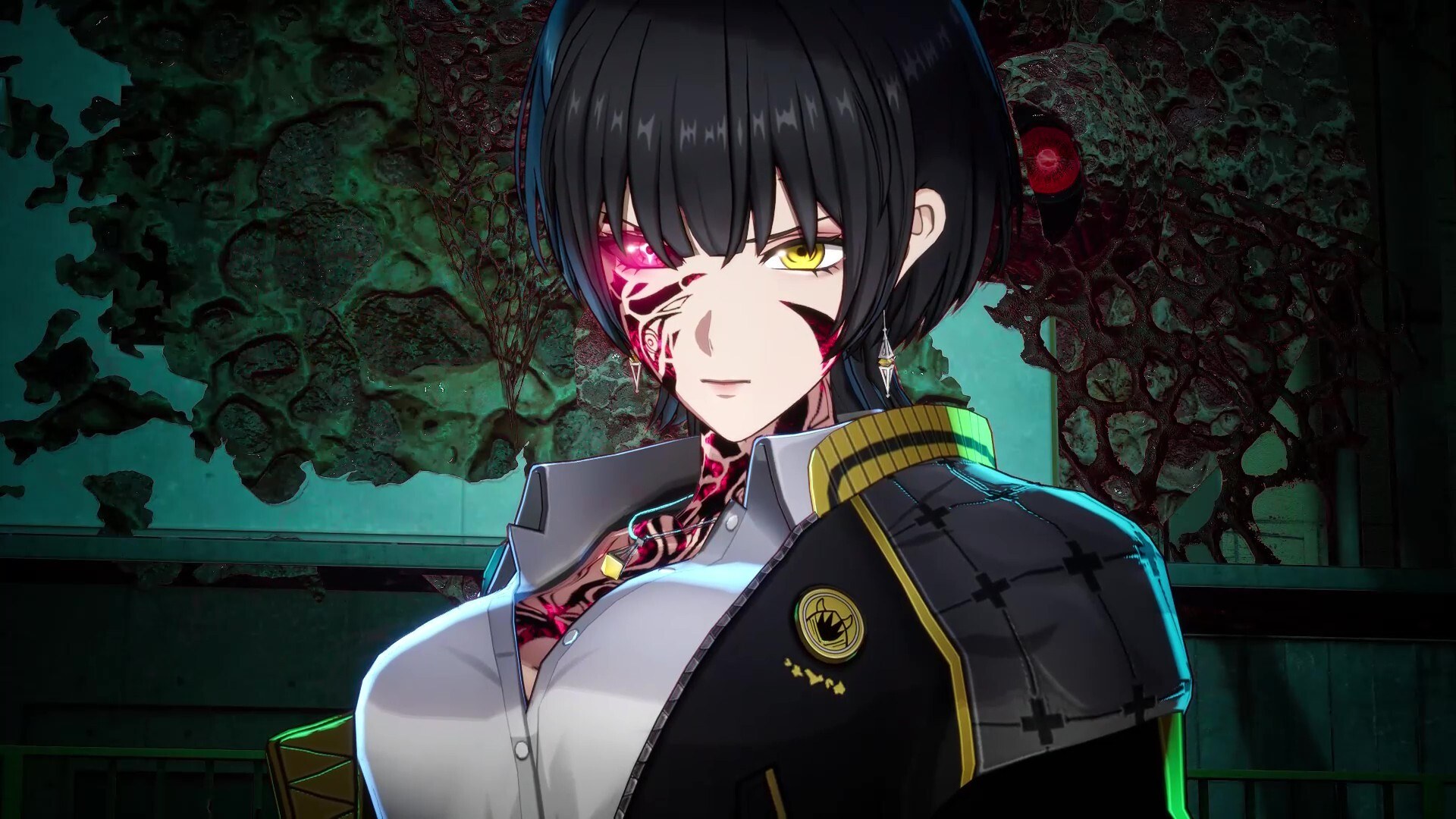
| Rena Hizuki (voiced by Ikumi Hasegawa) | 28-year-old investigator, Metropolitan Police Department, Public Safety Bureau, Foreign Affairs Section 5, 2nd Anomaly Investigation Unit | A Stigma centred on her chest, a Demon Eye that can see her own future, and an unsigned cursed ceremonial blade that functions as a key; she attacks with the power of severance rather than by slicing |
| Soma Hoshigami (voiced by Itsuki Tousi) | 20-year-old delivery worker classified as "lost property" after Rena takes him in; a mutant in a "half-turned" state toward Tier One | Stigmas on his lower abdomen and both arms; his mutation distorts the surrounding space, and he attacks by manifesting conceptual fangs and jaws through punches and kicks |
The Counter System in Practice
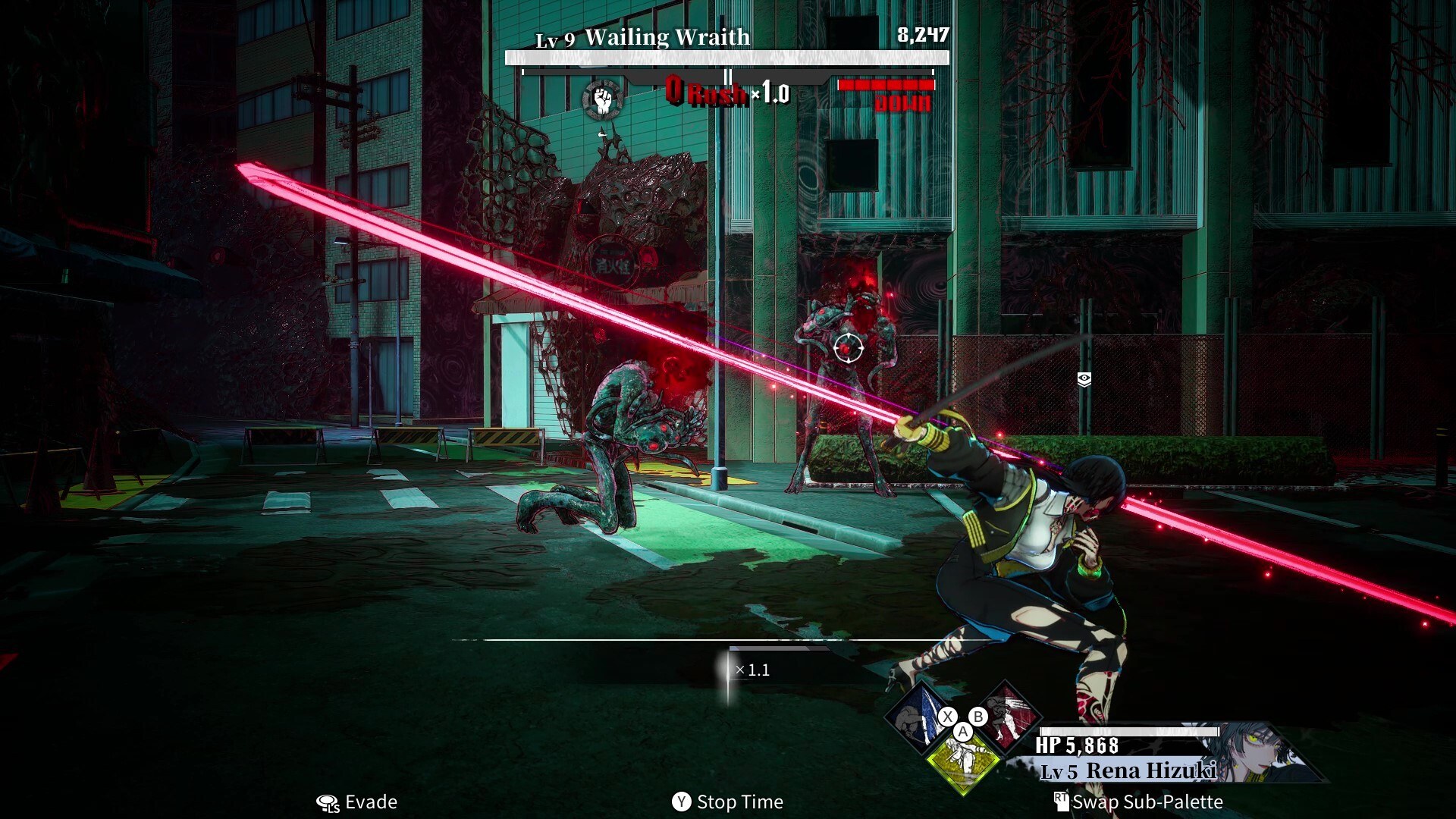
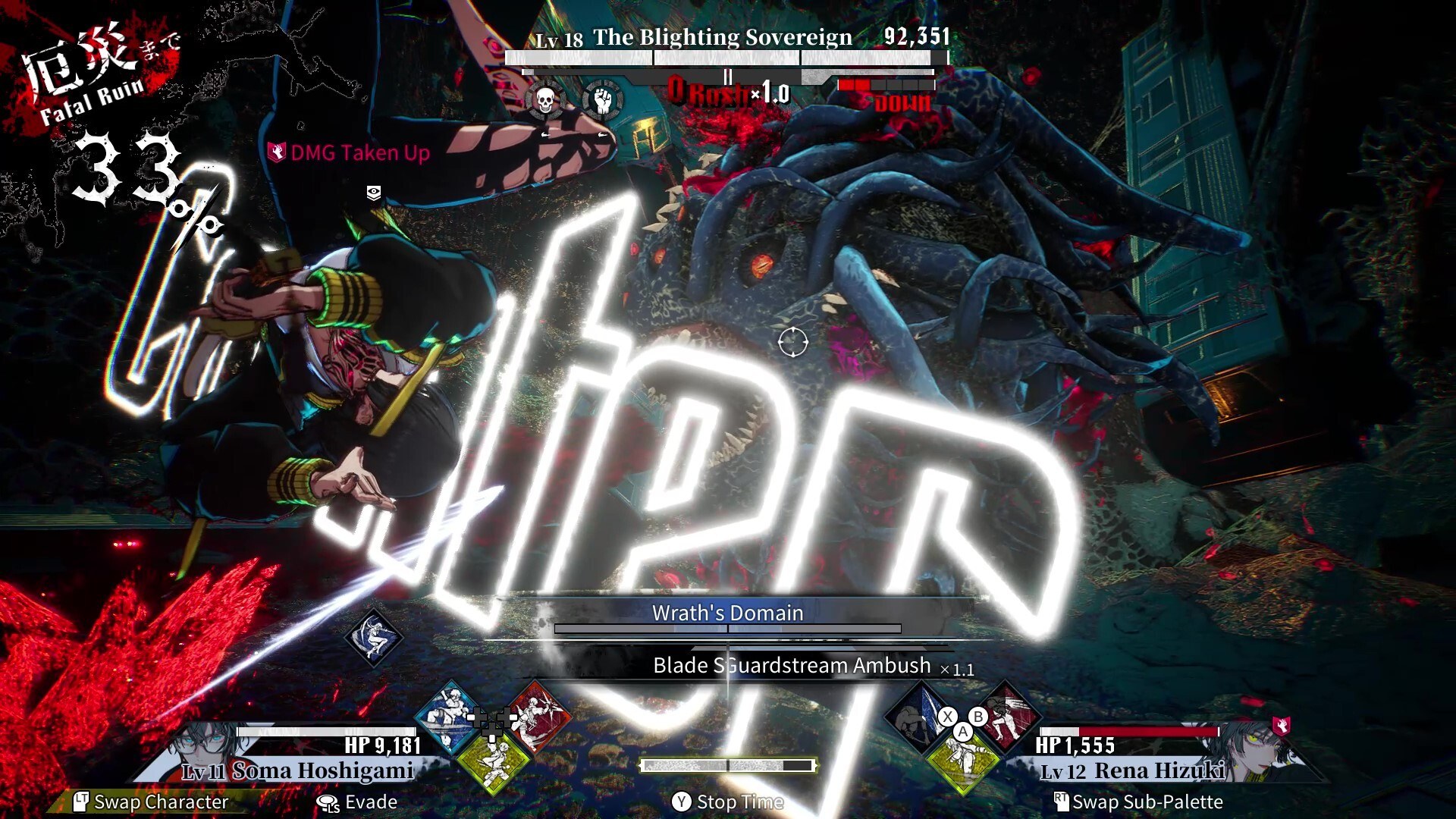
The official page describes the gameplay screen as pausable or slow-motion at any time, with battle information on screen so you can predict enemy attacks and watch your own skill recharge. RPGFan's review breaks that down into the actions you actually press.
| Action | How it is triggered | What it does |
|---|---|---|
| Colour-matched counter | Press the blue, red or yellow attack that matches the expanding enemy circle as the two circles overlap | Turns the attack back on the enemy and opens it to a heavy punishment window |
| Buddy Counter | Land a counter with the partner lined up for the assist | RPGFan reports it as the hardest-hitting version, especially when both characters commit at once |
| Guard | A single button press | A straightforward block that does not depend on the timing window |
| Stop time | A dedicated skill in the main skill wheel | Pauses the fight so you can plan the next attack string, or purge a queued string and re-enter commands fresh |
| Dodge | Reported as the fallback when a counter window is missed | Cancels the incoming attack and gives you another attempt, per RPGamer |
| Ultimate attack | The finisher after an enemy has been downed through repeated counters | RPGamer notes most regular enemies need a full counter-and-down cycle before they can be finished |
Because battles run in real time, you control the lead character on the face buttons while feeding directional commands to the partner, so a Buddy Counter is a two-hand job. RPGFan also notes that the enemy's predicted move pattern can scroll along the side of the screen, which is your cue for which colour is coming.
Skills, Research Points and Progression
Progression does not run on ordinary experience levels alone. RPGFan reports that investigating points of interest on the story map, or fighting battles, earns Research Points, and those points buy new skills or strengthen the effects of skills you already have equipped. You can only carry a handful of skills at once, so the skill wheel is a loadout decision rather than a checklist, and the game opens up support, buff and debuff skills on a secondary wheel as you advance.
RPGamer's review adds three details worth knowing before you spend anything. First, higher difficulty settings award more Research Points, which is the game's main way of letting a harder run fund itself. Second, completing battles also grants passive skills. Third, most passives are small stat increases, while a few trade one stat for another — and RPGamer reports the practical impact is hard to feel, with the passives rarely changing how a battle is played.
Where each skill actually lives:
- Primary skill wheel — the three colour-coded attacks of varying strength plus the stop time skill, per RPGFan.
- Secondary skill wheel — support, buff and debuff skills that open up as you progress.
- Guard — sits outside the wheels on a single button press, so it is always available.
- Loadout cap — you can only equip a handful of skills at a time, which makes the wheel a choice rather than a collection.
The Story Map, Five Chapters and the Time Limit
Outside combat, the game runs on a world map built from selectable points across the city. RPGamer compares it to the maps used in Shin Megami Tensei and reports that missions mark which locations to investigate, which keeps route choice limited; reaching a point triggers a visual-novel-style cutscene that advances the plot. RPGFan describes the same map as large enough to feel sprawling across all five chapters, with enough points of interest that you cannot realistically see everything in one run.
| Structure layer | Documented behaviour |
|---|---|
| Chapters | Five, spread across one large story map |
| Chapter limit | A cap on in-game days, with each day split into day and night |
| Going over the limit | Enemies become deadlier at an accelerated rate for every day you run past the cap |
| Day and night | Some areas cannot be reached at night, and others play out differently depending on the time of day |
| Clue sources | The map itself and an in-game social media feed, which together point at what to prioritise and when |
Difficulty, Length and New Game Plus
Both reviews describe adjustable difficulty, and RPGamer notes that the higher settings mostly raise enemy levels and health rather than changing the shape of a fight. RPGFan puts its own run at roughly sixteen hours and adds that mastering counters quickly would shorten that; RPGamer files the game under the twenty-hour mark. RPGFan also reports a New Game Plus mode for a second pass against stronger enemies.
One death rule is worth internalising early: RPGFan notes it is only a Game Over if both characters are knocked out at the same time, which makes a downed partner a manageable problem rather than a run-ender. On the store side, the Steam listing confirms single-player only, 46 Steam achievements, full controller support with DualShock and DualSense support, Steam Cloud and Family Sharing.
Practical Notes for Your First Chapters
- Treat the pause button as a planning tool rather than an emergency brake, and use it to read the predicted move before you commit a skill string.
- Learn the three attack colours early, because the counter window is decided by matching colour rather than by raw damage.
- Keep the partner's directional commands in mind even while the lead is mid-string, since Buddy Counters are where the biggest damage sits.
- Spend Research Points on strengthening skills you already use before spreading them thinly across new ones.
- Respect the chapter day cap. Going over it does not stop you, but the enemies keep getting worse for every in-game day you spend past it.
- Check the in-game social feed as well as the map, because some locations only open at the right time of day.
FAQ
- What kind of combat does the game use?
- A real-time partnership battle system built on counters rather than turn order. The official page describes it as give and take in which you stack skills over time to inflict damage, and RPGFan calls the result a fight that feels like an action RPG or a fighting game while keeping a turn-based sentimentality.
- How do the colour-coded counters actually work?
- When an enemy attacks, a blue, red or yellow inner circle grows out toward a matching outer circle. You press the attack of the same colour inside that window to counter; a miss still deals minimal damage, but a landed counter opens the enemy to a heavy follow-up, and a partner-assisted Buddy Counter hits harder still.
- How do you unlock new skills?
- Research Points. RPGFan reports that investigating points of interest on the story map, or fighting battles, earns Research Points that buy new skills or upgrade the ones you already have equipped. RPGamer adds that higher difficulty settings hand out more Research Points, and that clearing battles also grants passive skills.
- How long is a playthrough?
- RPGFan reports roughly sixteen hours for a single run, and RPGamer files the game under twenty hours. RPGFan also notes a New Game Plus mode for a second run against stronger foes, and the game is built across five chapters on one large story map.
- Does the game have a time limit?
- Yes, at the chapter level. RPGFan reports that each of the five chapters gives you a limited number of in-game days, each split into day and night, and that once you pass the limit enemies grow deadlier for every day you go over. Some areas are only reachable at certain times of day.
References
- Qliphah in Providence's Shadow — official game page (story, battle system, characters)
- Qliphah in Providence's Shadow on Steam (appid 3882410)
- Qliphah in Providence's Shadow Review — RPGFan
- Qliphah in Providence's Shadow Review — RPGamer
- Qliphah in Providence's Shadow Review - The Mystery of a Unique Action RPG System — YouTube
Facts on this page are compiled from the references above. Items marked "to confirm" are single-source and not yet verified.