Wanderburg · Game Guides · Guide
Wanderburg Gameplay — Core Loop and Castle on Wheels Systems
A Wanderburg gameplay overview of the core loop: driving the castle on wheels, devouring villages to grow, and building a modular siege arsenal between runs.
Wanderburg is a fast-paced, minimalist roguelike set in a medieval world of roaming fortresses, and its gameplay is built around a single inversion of the usual tower-defense setup: your fortress is mobile, aggressive, and constantly devours the landscape to sustain growth. The store page puts the fantasy bluntly - "Castles hunt, Villages flee. And only the biggest stronghold survives." This Wanderburg gameplay page breaks that loop into its documented parts, so you can see what a run actually asks you to do before you buy into Early Access.
What begins as a modest moving fortress quickly becomes a growing, devouring war machine that reshapes the battlefield with every run. The systems below are the ones the official description and the current fan documentation agree on.
What Kind of Game Wanderburg Is
The official description calls Wanderburg a single-player, isometric medieval roguelike about piloting a rolling fortress across dangerous landscapes. It is not a fixed-base defense game: the castle itself is the unit you drive, the weapon platform and the thing that grows. The store tags it with several genres at once, and the one-sentence pitch is about consuming rather than defending.
| Fact | Documented value | Source |
|---|---|---|
| Type | Minimalist medieval roguelike / action roguelike | Steam store page |
| Perspective | Isometric, single-player | Fan guide, Steam |
| Genres | Action, Casual, Indie, RPG, Simulation, Strategy, Early Access | Steam app details |
| Platform | Windows PC only | Steam app details |
| Price | $14.99 USD | Steam price data |
| Release | September 8, 2026 (Early Access) | Steam store page |
The scale of the world is part of the pitch. The description talks about steam-powered siege engines rolling beside arcane artillery, knights riding bicycles into battle, and massive strongholds firing broadsides like warships on land - a deliberately absurd medieval world where the biggest castle is the one that survives.
The Core Loop: Crash, Consume, Expand
The running order of a Wanderburg run is documented in four stages. Nothing here is exotic; the loop's hook is that consuming the map is also how you heal, grow and level, so movement and damage are the same action.
| Stage | What happens | Why it matters |
|---|---|---|
| Crush and consume | Steer the fortress through villages, wandering flocks and smaller fortresses | Consumed targets feed growth and the run's economy |
| Chassis expansion | Expand the moving castle and its modular layout | A bigger chassis carries more weapons and structures |
| Modular armament | Add siege machinery, arcane systems and explosives | Build identity forms from the pieces you choose |
| Meta progression | Unlock modules, vehicles, artifacts and captains between runs | Each run widens the options available to the next |
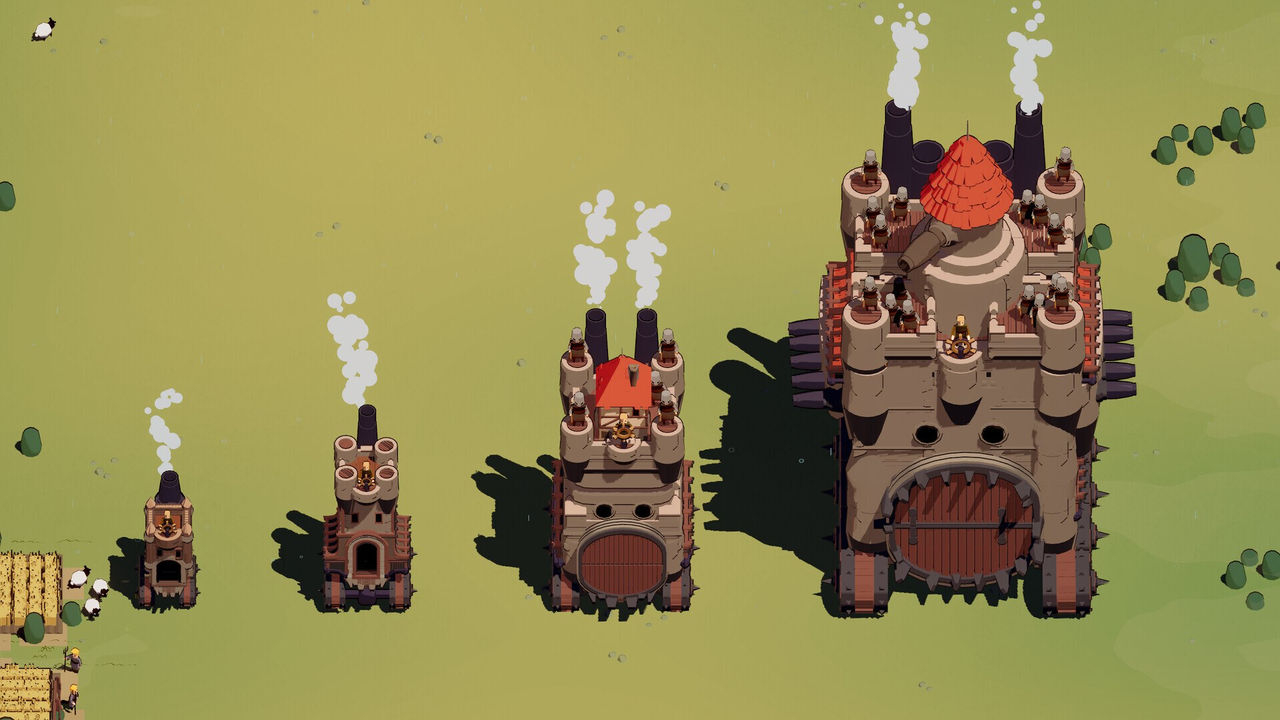
Your castle does not just upgrade - it expands. The store description stresses that the fortress grows into a war machine as you defeat powerful enemy castles, so boss victories are the moments that visibly change what you are driving, not just a stat increase.
Building the Modular Arsenal
The armament layer is where runs diverge. The official description names cannon mounts, arcane towers staffed with wizards, explosives, and the freedom to experiment with wildly different builds each run. A modular progression system lets you expand the moving fortress with new siege modules and structures, and the store explicitly invites players to try to break the game with the combinations they assemble.
The documented pieces that carry over between runs are:
- Modules - siege weapons, arcane systems and structures that define a build's damage and support roles.
- Vehicles - alternative castle chassis that change what a loadout can carry.
- Artifacts - passives and modifiers chosen around a run's plan.
- Captains - a crew choice with its own effect and trade-off, such as changing ability timing, Nitro recovery or damage taken while boosting.
For the full unlock pool, see the modules page; for loadout priorities, the best build page covers the current thinking. Captains have enough moving parts to deserve their own write-up on the captain page.
Between Runs: How the Meta Layer Works
Wanderburg is a roguelike, so a run ends and you return to a permanent account. The official phrasing is that unlockable vehicles, artifacts and captains "steadily widen your strategic options and build variety" between runs, while modules and vehicles open fresh strategies.
Two consequences follow. First, a strong run is not only about how far you got but about what it left unlocked. Second, the starting loadout matters more as the account develops, because a bigger starting kit reduces how much a bad upgrade draft can hurt you.
- In-run power comes from what you consume and the upgrades the run offers.
- Permanent power comes from unlocks and purchases made with the currency you earn.
- The two do not advance together automatically - opening new terrain does not by itself expand your starting module pool.
Steam currently lists the game as single-player only, so the loop is entirely about your own runs rather than co-op. For the Early Access caveats and what is still changing, see the release date page, and if platform availability is your question, the Switch page answers it directly.
FAQ
- What kind of game is Wanderburg?
- Wanderburg is a single-player, isometric medieval roguelike about piloting a rolling fortress across dangerous landscapes. The core loop combines movement, consuming settlements, expanding the castle and making modular build choices across runs, and it launched in Steam Early Access on September 8, 2026.
- What is the core loop in Wanderburg?
- You roll forward and consume everything in your path - fleeing villages, wandering flocks and smaller fortresses all feed your growth. Defeating powerful enemy castles pushes your evolution further, and between runs you unlock new modules, vehicles, artifacts and captains that widen your options.
- Do you aim the weapons yourself in Wanderburg?
- The design leans on driving and timing rather than manual aiming. On the store page the game is described as buildable and playable with mouse, keyboard or controller, and the wider kit maps to a small number of ability slots, so positioning and cooldown timing carry more weight than tracking a reticle (to confirm).
- Is Wanderburg single-player only?
- Yes. Steam lists Single-player as the only player mode, with no co-op, multiplayer or PvP tag on the store page. The multiplayer question is covered separately on the multiplayer page.
- Is Wanderburg turn-based?
- No. It is a real-time action roguelike: the castle moves continuously, enemies push toward you, and runs resolve in live play rather than in turns.
More in Game Guides
More game guides pages in Wanderburg.
Wanderburg Guide — First Run, Progression and Unlocks
GuideA Wanderburg guide to the first run and beyond: clearing the opening route, reading what blocks progress, the four progression layers and what to unlock next.
Wanderburg Review — Early Access Verdict and Reception
PageA Wanderburg review round-up for Early Access: the 8/10 pre-launch playtest score, the unrated post-launch verdict, Steam reception and current caveats.
Wanderburg Tips — Early Run Habits and Growth Plan
GuideWanderburg tips for early runs: finish the opening route, fix the right progression layer, keep movement as defence and plan what each run should unlock.
References
Facts on this page are compiled from the references above. Items marked "to confirm" are single-source and not yet verified.